

In just a few years, the way we search for information has shifted dramatically. Instead of typing keywords into a search engine and clicking through organic links on a search engine results page (SERP), millions now turn to AI assistants like ChatGPT, Perplexity, Claude, and Google’s AI Overviews to get direct answers.
This evolution is changing how brands think about visibility online. If you want your content to show up in AI-generated responses, you need to go beyond traditional SEO. Today, you need to optimize your content for large language models (LLMs).
This guide will show you exactly how to do that with 5 key tips for LLM and AI search optimization. Whether you’re a brand owner, marketer, or SEO professional, you’ll learn how LLMs work and how best to position your content for AI-powered discovery.
Let’s dive in.
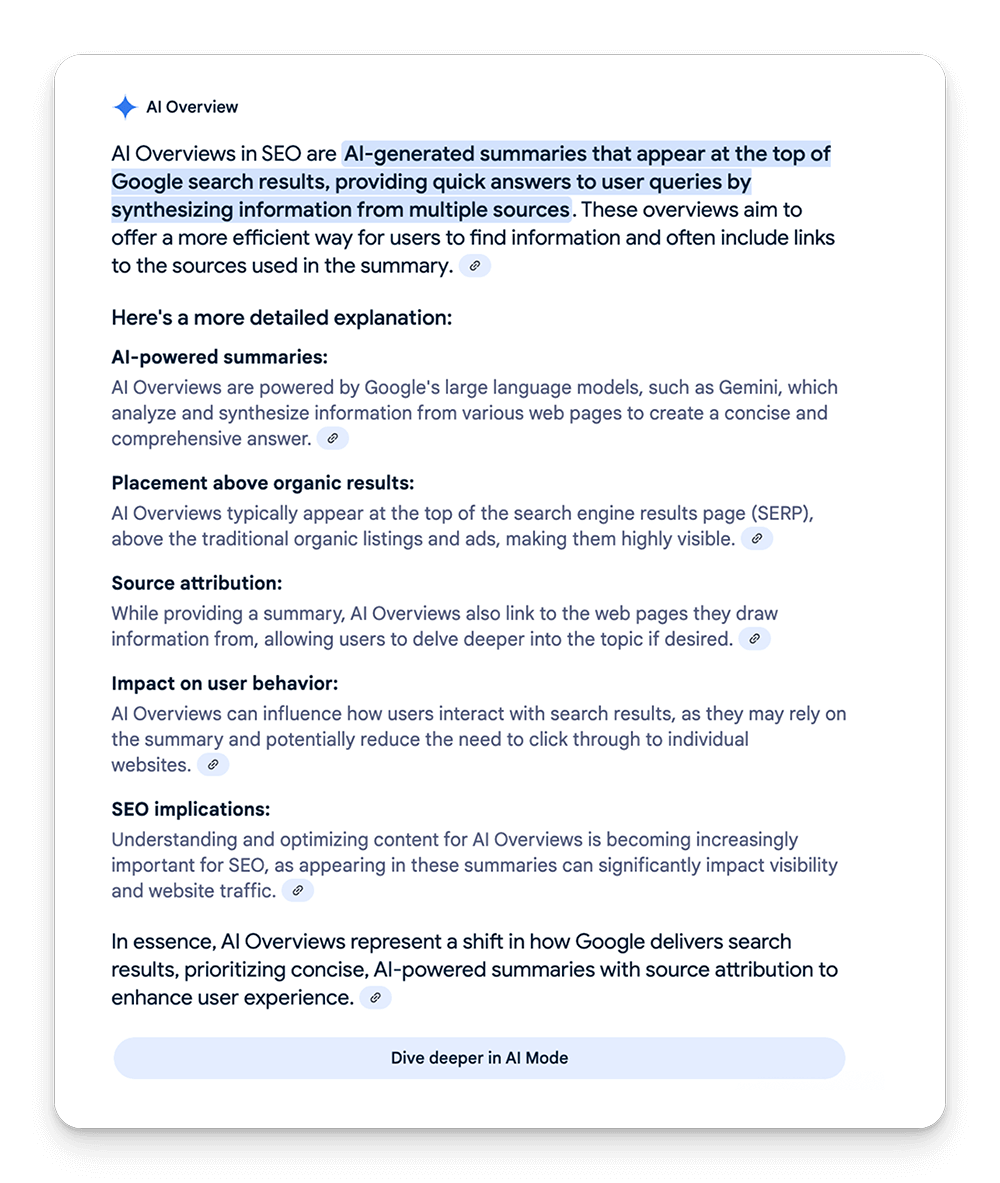
What is an AI Overview?
You’ll no doubt have seen AI Overviews at the top of Google search engine results pages (SERPs).
These new search elements are AI-generated summaries, powered by large language models (LLMs) such as Gemini. They gather information from a variety of trusted online sources to provide concise and relevant answers to users.
Positioned above organic and paid ads in Google, AI overviews have been designed to provide quick and helpful answers.
Users can see where the AI overview has sourced its information through a link icon. This is where users can click through to learn more if they choose to, verify or expand on the information provided in the summary.
Users are already relying on AI Overview summaries, so click-through rates to individual webpages are declining, influencing web traffic volumes and engagement.
Artificial intelligence optimization (AI Optimization) for Google AI Overviews is therefore becoming an essential part of any SEO strategy, helping brands maintain visibility and authority in a changing search landscape.
What is LLM optimization?
LLM optimization is the practice of creating and structuring content in a way that makes it more likely to be selected, synthesized, and cited by AI tools powered by large language models (LLMs) such as ChatGPT, Gemini, Claude, and others. This is a proactive approach to digital content strategy.
LLMs don’t “crawl” websites like traditional search engines do. Instead, they are trained on huge datasets, including publicly available web pages, forums, books, and licensed sources (for example, OpenAI’s 30+ data partnerships with organizations like Business Insider, Politico, and Reddit).
LLMs use this training to generate human-like responses to user queries. Some LLMs can also access real-time web content via plugins, APIs, or retrieval-augmented generation (RAG).
Optimizing for LLMs means understanding how they source and generate responses. It also means making your content more “machine-readable,” reliable, and contextually useful to those models. This specialized form of optimization ensures the useful information you create is ready for the new AI frontier.
Ready to optimize your content for AI search engines?
At Hive19, our specialist writers create content that’s not only engaging for readers but also structured for visibility in Google’s AI Overviews and LLM-powered tools. Learn more about our copywriting services.
Now, onto our top 5 tips for LLM optimization!
Tip 1: Use your brand name in context
Many websites speak in the first person. They use phrases like “we recommend this” or “we’ve found that.” Often, they do so without ever naming who “we” is. AI models won’t always connect the dots there.
So, be explicit. Use your brand name consistently and naturally throughout your content. For example:
“At Hive19, our link building services provide tremendous value to brands in this new era of AI search.”
Or…
“According to the latest data by ClickBank, the top niche for affiliate marketing in 2025 is dietary supplements.”
This context helps AI tools associate your brand with topic-specific ideas and insights when building topical authority. It’s especially important when the LLM is summarizing multiple sources.
More than ever, brand mentions add credibility and context.
This consistent naming approach reinforces your brand as a recognized entity in your niche and boosts overall visibility.
Tip 2: Earn quality backlinks and rankings
While LLMs don’t rely on PageRank in the traditional SEO sense, they still use trust signals to determine authority.
Several studies have found a correlation between being ranked on the first page of the SERPs in either Google or Bing and getting cited in AI overviews and LLMs.
Agencies like Grow and Convert found that in 400 bottom-of-funnel queries where they ranked on page 1 of Google, they also showed up in AI search 77% of the time. And in cases where they ranked in the top 3 spots on Google for a given term, the correlation is even stronger.
Clearly, LLMs like ChatGPT (with Browse) and Perplexity prefer highly ranked sources to cite when generating their responses.
Why it matters
Many AI tools prefer content that already performs well on Google or other popular search engines. If you rank for relevant organic search queries, you’re more likely to be included in AI-generated summaries, including Google’s AI overviews and AI Mode. High-quality backlinks signal both search engines and LLMs that your content is valuable and trustworthy.
What to do
Focus on digital PR, guest blogging, thought leadership, and other link building strategies to earn high-authority backlinks. Prioritize links from trusted domains in your niche. Think about reputable .edu, .gov, or well-known industry sites. These backlinks demonstrate your site’s authority and improve your visibility in the eyes of AI.
Looking to strengthen your backlink profile for AI features?
At Hive19, we focus on relevance-first backlink building. Earning authoritative links from trusted domains that improve both your search rankings and visibility in Google’s AI Overviews. Start earning backlinks today!
Tip 3: Target questions instead of just keywords
Traditional SEO is often focused on short-tail, high-volume keywords, but LLMs respond best to complete questions, because that’s how users engage with them through prompts. LLMs are specifically designed to understand natural language queries.
So, instead of optimizing your content for a traditional search query like “top aligner benefits”, get into the head of your prospects and determine the questions they’re asking.
For example: “What are the advantages of clear aligners over traditional braces?”
Or instead of “best running shoe,” address “Which running shoes are best for long-distance training?”
Or instead of “website speed” answer “How does website speed affect user experience and SEO?”
This is a good idea both at the article level (e.g., writing an entire article around a question keyword) and within articles and pages themselves.
One best practice is to write 3-5 FAQs in your articles that directly answer user questions using clear, natural language. Leverage tools like AnswerThePublic or AlsoAsked to discover real user questions you can address in your content.
Example:
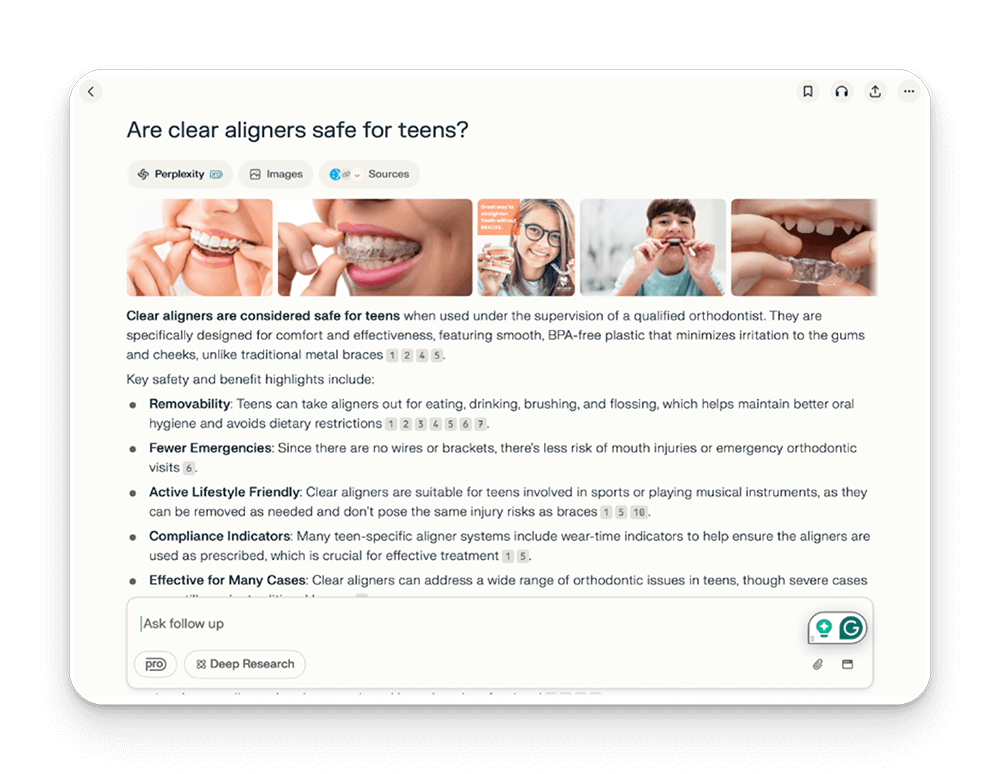
A dental practice might add a section titled “Are clear aligners safe for teens?” and provide a short, structured answer for a parent who’s researching teeth straightening options for their children.
This is much more likely to be cited in an LLM-generated response than vague or keyword-stuffed content, such as in the Perplexity example above. Use a direct approach to make your information highly accessible to LLMs.
Tip 4: Use Structured Data and Schema Markup
Structured data helps machines understand your content better. Schema markup can clarify your content topic, who wrote it, and which entities are involved. It provides explicit clues to LLMs about the meaning of your information.
I’ve seen structured data or schema called “subtitles for machines” Here are some of the most helpful schema types for LLM optimization:
FAQPage,Question,Answer: For question and answer sections.Article,NewsArticle,BlogPosting: For general articles, blog posts, and news.Organization: To identify your brand and its official name.Author: To attribute content to specific individuals.Product: For detailed product information.Recipe: For cooking instructions and ingredients.Review: For user or editorial reviews of products or services.LocalBusiness: For businesses with a physical presence or service area.
Adding schema doesn’t guarantee you’ll be cited, but it significantly increases your chances. Schema makes your content more machine-readable and easy to reference, which provides a clear framework for LLMs to process your information efficiently.
See the full list of schemas that Google Search supports.
⚡ Pro tip: Validate your schema using Google’s Rich Results Test and Schema Markup Validator. Then, be sure to regularly audit for errors. Errors can prevent your structured data from being used effectively.
Tip 5: Use lists, tables, and semantic keywords
LLMs love structure. Bulleted or numbered lists, comparison tables, and well-organized sections help AI models quickly extract and summarize your content. This clear formatting aids in rapid information retrieval.
Use lists to make content skimmable and scannable
You can use lists to turn walls of text into skimmable and scannable content.
For example, instead of writing a paragraph about the benefits of clear aligners, structure it like this:
Benefits of clear aligners:
- Nearly invisible.
- Removable for meals and cleaning.
- More comfortable than metal braces.
- Require fewer dental visits.
- Often result in shorter treatment times.
- Easier to maintain oral hygiene.
This format makes it easier for LLMs to pick up and include your points in responses, especially when users ask for a quick rundown or comparison.
Overall, lists will enhance the discoverability of key facts for both LLMs and human readers!
Include semantic keywords and related concepts
Semantic keywords are conceptually related terms that provide context. For example, if you’re writing about electric cars, include terms like:
- EV.
- Charging station.
- Range anxiety.
- Battery life.
- Tesla, Nissan Leaf, Ford Mustang Mach-E, etc.
- Sustainable transportation.
- Emissions-free driving.
- Public charging infrastructure.
This helps LLMs build a deeper understanding of the topic you’re covering, which increases your chances of appearing in long-form, nuanced answers. Semantic density signals comprehensive coverage to AI.
Tools to find semantic keywords
It’s not always easy to think the same way a computer or LLM does, which is why AI SEO optimization tools can be helpful for finding semantic keywords.
Here are a few of the top tools we recommend:
- Google’s “People Also Ask” and “Related Searches” sections.
- SurferSEO.
- Clearscope.
- Semrush or Ahrefs keyword tools.
- Google Keyword Planner (for related terms).
- Topic clusters generated by AI content tools.
Distribute these semantic and related keywords naturally throughout your content for a chosen topic, and AI tools will be more likely to reference and source what you publish.
LLM and AI optimization wrap-up
Large Language Models have fundamentally shaken up the digital landscape, which means content strategy has to evolve too.
To recap our list of 5 tips, optimizing for LLMs and AI search requires a comprehensive mix of:
- Strategic branding: Consistently use your brand name in context to build entity recognition.
- Technical clarity: Implement structured data and schema and ensure excellent site speed and accessibility.
- Semantic richness: Leverage related keywords for deeper contextual understanding.
- User focus: Directly answer real user questions and craft content for every stage of the user journey, especially bottom-of-funnel queries.
- Authority building: Earning high-quality backlinks, adhering to E-E-A-T principles, and building an external reputation.
Above all, your content must be genuinely useful. When your content solves real problems and speaks directly to your audience’s needs in a way that LLMs can easily interpret, you dramatically increase your chances of being featured, cited, and remembered.
It’s no longer enough to rank on page 1. Today, the brands that win are the ones that speak clearly to both people and machines.
Embracing LLM optimization isn’t just about adapting to a new technology – it’s about securing your brand’s future visibility and influence in the evolving digital age. The journey into AI search is ongoing, but a proactive approach will ensure your continued success. Best of luck!
Below, we’ve answered some of the most common questions associated with how to optimize SEO content for AI Overviews and LLMs.
AI Overviews and LLMs FAQs
How to turn off AI Overview?
There is no way to turn off Google Ai Overview. However if you want to display only traditional web search results, you can filter them out. For desktop users; after entering a search query, click the More tab (next to Images, News) and select Web. For mobile users; after performing a search, tap More at the top of the results, then select Web.
There are also options for Chrome and Edge extensions such as “Hide AI Overviews” or “Bye Bye, Google AI” from the Chrome Web Store.
How to optimize for answer engines?
Structure your content in a clear question-and-answer format. Use the query as a heading or subheading and follow it with a direct, 30–60 word answer. Position the strongest part of your response at the start, then expand with supporting details. Avoid jargon by using simple language and including bullet points or short paragraphs and add Schema Markup to improve visibility in AI Overviews and other LLM-powered answer engines.
What is the difference between AEO vs SEO?
SEO (Search Engine Optimization) focuses on improving rankings in traditional search results, while AEO (Answer Engine Optimization) aims to make content more accessible to AI-driven tools like Google AI Overviews and LLM-powered platforms. SEO prioritizes keywords, backlinks, and technical health. AEO prioritizes concise, structured answers, schema markup, and clear context for machine readability.
About the authorDaniel Thrasher is the Senior Content Manager at ClickBank, a popular affiliate marketing network for brands and marketers looking to grow their sales online. Daniel creates value-packed content for brand owners looking to power their affiliate programs and scale their sales and affiliate marketers who want to find quality products to promote. Over the past 25+ years, ClickBank has paid out more than $7 billion in commissions. |

|