Whether you’re a marketer, a business founder or an SEO professional, understanding Google’s EEAT framework is crucial to creating content that people want to read, share and understand.
By aligning the work you publish with Google’s EEAT guidelines and frameworks, you can provide users with content that answers their questions, provides value and creates trust between you and the reader.
In time, you’ll also be rewarded with better chances of ranking well in search and building audience trust, all while enhancing your ongoing marketing strategy.
Not sure where to start? In this guide, we’ll cover what EEAT is, why it’s important for your website’s ranking and how you can start incorporating it into your content.
As a quick example of EEAT in action, this blog is written by me, Maxine Bremner, the co-founder of Brighton-based link-building agency Hive19.
I’ve worked in digital marketing for over 10 years, and specialise in content marketing – having helped some of the fastest-growing startups in the UK implement the EEAT principles I’ll be discussing in this article. With knowledge that stems from experience and expertise, I’m already ticking off the tasks on my EEAT checklist.
What is people first content?
People first content is central to Google’s helpful content. It also intersects directly with EEAT principles.
Key criteria for creating people first content include:
- Providing original insights, reports and perspectives.
- Answering your audience’s questions.
- Using reputable sources and expanding on the information cited.
- Using relevant and descriptive headings.
- Bringing new value or insights to the topic that go beyond what’s already available.
These principles are designed to reduce low quality, spammy content in the Google SERP, including keyword-focused and AI-generated content.
By developing people first content, you ensure the resources you publish inform, guide and help your target audience.
While Google doesn’t actively penalise AI-generated content, it could harm your ranking as it doesn’t create Helpful Content with unique insights. It also won’t provide more value than other content, making it less useful to your audience.
Google states in its guide to creating people first content that content should be written or reviewed by an expert on the topic to:
- Ensure accuracy and trustworthiness.
- Prevent harm when discussing sensitive topics, such as when giving legal advice or medical guidance.
- Combat misinformation.
- Ensure the content satisfies user search intent based on the expert’s understanding of what the target audience wants to know.
People first content in action
At Hive19, we’ve been producing people first content for our client, SumUp, the payment provider you’ve probably spotted (or used!) in your local coffee shop, farmer’s market, barbershop or food truck.
Their long form resource blogs, written by our niche expert writers, are a great example of helpful, people first content.
Created for the small business merchants that use SumUp products, the content targets common hurdles when starting a brand, like coming up with a business idea and conducting market research.
When creating people first content, follow our EEAT checklist and EEAT best practices to ensure every blog you publish is credible, helpful and genuinely valuable to the reader:
- Identify evergreen content ideas to ensure it remains valuable over time and serves readers long after it’s published.
- Use the most recent and relevant industry statistics to support claims.
- Source quotes from industry experts where appropriate.
- Include FAQs to directly answer reader questions quickly.
- Organise content logically with the correct H-tags.
- Periodically reviewing the content to ensure it’s up to date.
- Internally link to other relevant supporting content within the same topic cluster.
- Tailor content to your target audience using relevant real word examples.
- Create actionable checklists and guides.
- Break down larger topics into subtopics and related queries.
The evolution of Search Quality Rater Guidelines (SQRGs)
SQRGs are specifications that Google’s team of human evaluators use to manually assess your website against EEAT principles. They consist of:
- Page quality: how well your content achieves its purpose and avoids harmful content.
- Needs met: how useful your content is for specific user queries.
Google updates SQRGs frequently. In 2018, they published a Core Update that highlighted the importance of expertise, authoritativeness, and trustworthiness (EAT).
In 2022, there was a Google E-A-T update that added an ‘E’ to their guidelines. This was the introduction of Experience, turning E-A-T into EEAT.
By doing so, Google made it clear they wanted their users to receive information from experts with personal, direct knowledge.
In 2023, a further Google EEAT update applied the same principles to product reviews. They also rolled out the Helpful Content update, emphasising the need for people-first content that aligns with EEAT standards.
What does the EEAT acronym stand for?
EEAT stands for experience, expertise, authoritativeness and trust. You might also see the EEAT acronym presented as E-E-A-T.
A deep understanding of Google’s EEAT guidelines helps you implement these principles throughout your website copywriting and marketing material.
To learn more, let’s start with the EEAT definition and break it down into its individual parts.
Experience
Google values real world knowledge and first hand experience. When creating content, your business needs to showcase credibility in your specific niche with insights into your hands on experience.
For instance, if you sell customer relationship management (CRM) software, you could highlight real world experience by sharing case studies of how your work has benefited clients.
A blog post outlining how you helped a business streamline its sales process using your CRM provides evidence of your practical knowledge and the impact of your software.
Adding a client testimonial further strengthens your credibility by offering an authentic, first hand validation of the results.
Expertise
To Google, expertise adds to the people first nature of helpful content.
While similar to ‘experience’, Google wants to ensure you’re a trusted authority. It differs from experience by encouraging you to focus more on your understanding of the topic, rather than first hand experience.
For instance, an article discussing the future of Fintech could be written by someone who has developed Fintech software or has a relevant degree, such as a Master’s in financial technology, finance, computer science, or a related subject, that certifies them as a Fintech specialist and proves expertise.
Authoritativeness
When exploring EEAT’s meaning, authoritativeness refers to your website or brand’s credibility. You can think of it as your business reputation.
There are several ways you can build your brand authority, such as citing other reputable sources in your E-E-A-T content and featuring expert contributors.
Topically relevant link building from authoritative sources is one of the most powerful methods to strengthen your position as an authority in your industry.
This strategy involves acquiring inbound links (or backlinks) from credible sources that reference your content within the text.
You can also develop about and bio pages that help Google understand more about who created your content.
This can include a page that introduces your entire team, like Hive19’s Meet the team page. You can also expand the digital footprints of each team member with an individual about page, like my page: Maxine Bremner, which tells Google – and our audience – more about me.
Need to boost your brand’s authority online?
At Hive19, we provide expert link building services to secure quality, relevant backlinks and showcase your website as a trustworthy source. Learn more about link building
Trustworthiness
Google cites trust as the most important of the EEAT factors, with each of the other EEAT principles working to support it.
You can build trust in your business by being consistent, transparent and accurate.
For example, if you offer B2B software or services, demonstrating compliance with industry standards builds trust instantly. You might highlight certifications that prove your business meets strict security and operational benchmarks, which is particularly important in industries such as Fintech.
Add clear data security policies in line with the UK Data Protection Act, for instance, and use easy to understand language when explaining how you keep your clients’ data safe.
What does EEAT mean, and why does it matter?
Google’s EEAT concept aligns with their focus on helpful content and aims to reduce unoriginal, low-quality content by 40%.
It encourages content creators to focus on publishing accurate, trustworthy insights that address a specific audience.
First time hearing about ‘helpful content’?
Get to grips with this crucial concept and learn how it can improve the quality of your content in our guide. Download our helpful content checklist
For example, if you’re writing an article on reducing financial debt, you might research your target audience’s frequent search queries to ensure your content answers their questions.
To validate the trustworthiness of your article, you might also add links to Citizens Advice to support your claims.
Google uses EEAT to assess the quality of websites and content, and ensure they’re displaying helpful, people first search results to their users.
In this way, it also becomes a cornerstone of how websites are ranked in the search engine results pages (SERPs), with Google favouring content that displays strong EEAT signals. This makes it a crucial aspect of both content marketing and search engine optimisation (SEO).
What is EEAT in SEO? E-E-A-T Signals and Impact
EEAT aligns with Google’s push for helpful, people first content and creates what the search engine considers to be quality results.
Though not an official ranking factor, if you demonstrate strong EEAT signals, Google will likely reward your content with better visibility in search results.
As a business, understanding how Google’s evaluators are manually assessing your website can help you develop content that meets their EEAT guidelines and, as a result, serves audiences better.
Evaluators look for signals such as:
- Clear author attribution with relevant credentials and bios.
- Citations of reputable sources and evidence of original research.
- Unique, first hand experience.
- A strong online reputation, including positive reviews and mentions across trusted third party platforms.
By aligning your E-E-A-T content with these expectations, you’re more likely to gain visibility in search results.
How to incorporate an EEAT strategy into your content marketing
Creating content for EEAT? Our EEAT checklist will help align your content with Google’s standards.
Online reputation
Consider where your authority lies and how your content can bolster your reputation through content marketing. This can include strategies such as:
- Publishing expert-led blog posts or whitepapers.
- Partnering with experts in your industry.
- Showcasing client success stories and testimonials.
- Contributing guest articles to reputable industry sites.
- Collaborating with credible influencers.
For example, if your business creates apps that help people manage their finances, you might ask a certified financial planner to co-author a series of blogs for people struggling to save money. They might also provide a testimonial for your app, increasing your credibility.
Are content creators experts?
Google recently began identifying content creators as experts in their field.

“This is a significant E-E-A-T development for content creators as it gives visible and meaningful proof that Google has recognised them as credible sources of information on a specific topic.
It’s also a huge advantage in modern SEO, since the person’s content is more likely to appear in today’s search results and tomorrow’s AI-powered assistants.”
– Jason Barnard, CEO and founder of Kalicube.
This can provide a boost to your EEAT strategy, either from:
- Becoming a recognised expert: if you consistently publish content that follows the EEAT framework, Google may recognise you as an expert, instantly establishing your credibility, expertise and authoritativeness.
You may even be able to claim a Knowledge Panel as an expert to certify your place as a thought leader and gain more visibility in the search results.
- Working with experts: partnering with content creators already verified as credible experts can signal to Google that you’re a valuable resource by association.
Local presence
Establishing a clear presence in your local community can create trust for local search queries.
For instance, if you run a SaaS platform that helps retailers manage their inventory, you might publish case studies from local clients.
You could also post videos on your social media channel of your team working with local businesses in person to verify your credibility with a local audience.
Remember to set up a Google Business Profile (GBP) and include accurate business information. A business name, address and phone number (NAP), for example, adds to the legitimacy of your business.
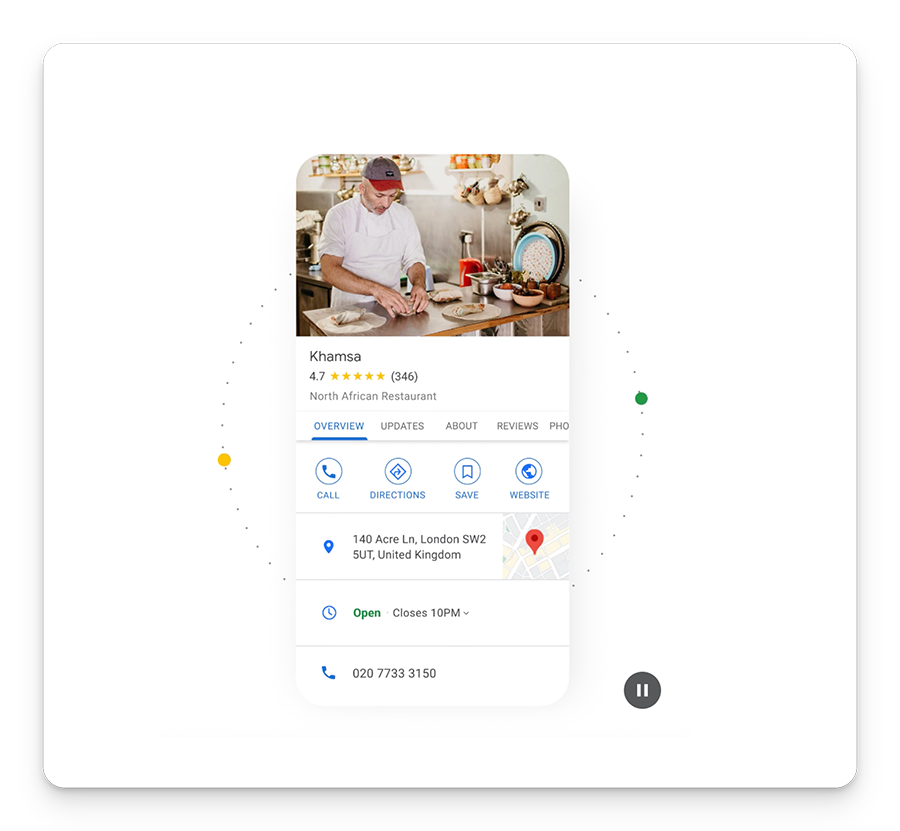
You can also encourage reviews, add business categories, and upload images of your premises, team and products or services.
These all help show you’re a legitimate, human-run brand and make it easier for your audience to learn more about your business.
Author reputation and thought leadership
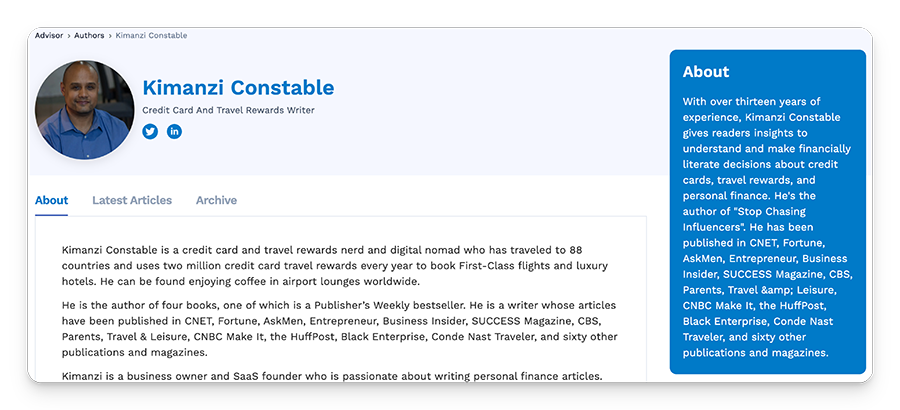
Use credible authors when publishing content. Add short bios that include relevant qualifications, job roles and experience.
You might also highlight work they’ve published on other platforms to identify your authors as thought leaders. For instance, if your head software developer has contributed to well-known tech publications, include these details in their bio.
Does UGC boost EEAT?
UGC (user generated content) is content created by your customers. For example, one of your customers might write a short post for your website explaining how your software helped their business.
93% of marketing experts believe that consumers trust UGC more than content created by your business.
Adding UGC to your marketing strategy, therefore, can be a great way to increase your trustworthiness, boost engagement and strengthen your E-E-A-T signals.
On-page EEAT
Ensure your content communicates who created it, how it was made and why it exists to align with Google EEAT guidelines.
You can also strengthen your EEAT signals by citing credible sources, adding details of professionals who have reviewed your content and including the latest date the work was updated.
Using schema for on-page EEAT
When looking at ‘what is EEAT’ in SEO, it’s important to consider the technical SEO techniques that can enhance your credibility and trust.
Adding elements like author schema markup helps search engines identify who created your content and why they’re qualified to do so.
Similarly, using structured data on your About and Contact pages improves transparency by making it easier for both users and Google to verify who you are, what you do and how to get in touch.
Off-page EEAT
Reinforce trustworthiness by acquiring quality backlinks, media coverage, guest posts and citations.
Positive signals from other reputable websites strengthen your site’s authority and benefit both E-E-A-T and SEO.
Unsure where your brand is being mentioned online?
Unlinked brand mentions are a goldmine for turning passive citations into powerful, authoritative backlinks. Turn citations into links
The best EEAT examples across industries
To learn more about how to apply EEAT frameworks, look at real world scenarios. Not only does this add context to the principles, but it can also inspire your own strategy.
In this section, we’ll explore 2 brands that are successfully following EEAT in their marketing.
Hubspot’s thought leadership
HubSpot, a well known software and tools provider for businesses, has established itself as one of the most influential thought leaders in digital marketing. A large part of their strategy is directly linked to EEAT principles.
For instance, for all published content, you can click on the author and read a detailed bio with a breakdown of their experience, qualifications and achievements.
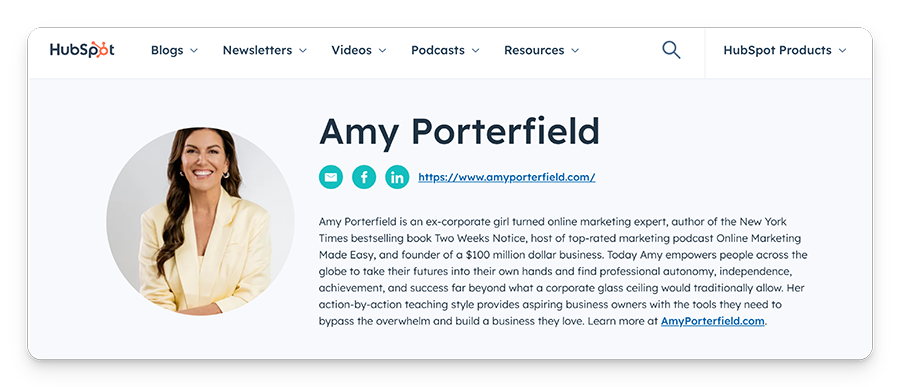
HubSpot also excels at:
- Offering in-depth resources like reports, guides, and courses.
- Building a strong online reputation through reviews and partnerships.
- Clarifying their audience size, such as when using the call to action “Join 600,000+ fellow marketers” to encourage users to sign up for their email newsletter.
- Using real people in their social media content, such as when creating videos to show how different features work.
They also publish first-hand experience pieces through their Creator Column, such as the blog Learn from My Mistakes: 7 Digital Course Pitfalls to Skip, written by a New York Times bestselling author and host of a top-rated marketing podcast.

What are the common mistakes with EEAT?
We’ve explored brands that are fulfilling EEAT criteria, but what about common mistakes? When developing an EEAT strategy, keep in mind these pitfalls to avoid.
Outdated author bios
Author bios with outdated, inaccurate or contradictory information can tarnish your credibility.
For example, you might publish a bio that describes the author as your marketing manager. If they’re promoted and their job title changes, this would no longer be accurate.
To provide up to date information, regularly update author bios.
You can make updates easier with individual about pages for your authors. Link to the about pages in your content. When you need to update details, you can do so on the author’s about page, rather than having to edit bios across your content.
When writing bios, avoid using terms that become quickly outdated, too. For instance, instead of writing ‘The current #1 viewed fintech YouTuber’, write ‘A top-ranked fintech YouTuber with over 600,000 subscribers’.
Lack of first-hand experience
Content that feels generic, AI-generated, or lacks a unique insight from your author or business can weaken your EEAT signals.
To strengthen content from an experience perspective, include direct quotes from team members or experts, examples from client case studies and step by step guides based on your unique product.
For example, instead of writing a generic guide to CRM software, include:
- Specific instructions for how to use your software.
- Stories of how different features have benefited your clients.
- Challenges faced by different clients and how you’ve helped to solve them.
These details build trust with your audience and align with Google’s emphasis on useful, experience-led content.
Missing business information
If your contact details are difficult to find or missing altogether, it can raise red flags for both Google and your audience.
To gain trust and improve user experience, ensure you display your contact information clearly on your website.
This should include your business address (if applicable), phone number and email address. You might also have links to your social media profiles.
Remember to also set up an accurate GBP to ensure your business information is highlighted in Google search results for local users.
Poor customer support
21% of customers have increased their spend with a business due to the excellent service and support received.
If your customer support isn’t meeting expectations, you might lose the trust of your audience. This can lead to poor testimonials, signalling that you’re not prioritising your users.
Poor customer support typically has long response times, unhelpful or generic replies, inaccessible contact options and a lack of resolution on issues.
These experiences damage both customer relationships and your online reputation. To align your support with EEAT principles, you need to:
- Make it easy to contact your team.
- Respond promptly.
- Use personalised responses rather than auto-generated replies.
You can also publish helpful content on your website, such as FAQS and troubleshooting guides.
Unclear privacy and security policies
Vague privacy and security policies can undermine trust in your business. It may signal a lack of transparency, with outdated statements and unclear policies harming your authority.
Use SSL certificates, data compliance badges (like the Certified Information Privacy Professional (CIPP) badge) and secure payment icons as trust signals, and regularly update information to reflect current protocols.
Underestimating footers and contact pages
Your footers – the section at the bottom of your website that displays important information – and contact pages shouldn’t be underestimated.
When sending trust signals to your customers, these areas of your website are ideal for reinforcing your brand’s credibility with clear contact details, links to your privacy and security policies, and industry certifications.
At Hive19, we analyse thousands of websites every month as part of ongoing research for our clients. While it’s not a hard and fast rule, we can tell a lot about a website from the footer.
Reputable websites with great user experience have comprehensive footers with business details and useful descriptive links. If a business hasn’t focused on its footer, it can indicate that its website isn’t optimised for its users and hasn’t considered audience’s navigation needs.
What is YMYL?
YMYL stands for Your Money or Your Life. It’s a Google coined phrase that’s closely linked to EEAT and is particularly important for businesses that are involved in financial advice and health services.
YMYL definition
The YMYL meaning is described by Google as representing topics that can “significantly impact the health, financial stability, or safety of people, or the welfare or wellbeing of society.”
How does Google evaluate YMYL content?
For YMYL sites and content, Google’s evaluators apply higher Page Quality (PQ) standards.
PQ standards determine the trustworthiness and quality of the user experience of a website or web page.
Lower PQ standards could negatively impact the people consuming YMYL content. This might mean that it harms their financial stability or health. It may also have a wider impact on the wellbeing of society.
For example, if you run a finance company and publish a blog post about investment strategies that includes outdated or misleading advice, it could lead readers to make poor financial decisions.
Larger scale financial information that’s incorrect could also impact the wider economy.
When evaluating YMYL, Google raters will be vigilant to ensure your website and business meet EEAT standards. Quality Rater Guidelines for EEAT and YMYL include checking:
- The content is accurate and well researched.
- The author is experienced and credible.
- Insights are backed up by statistics and facts from credible sources.
- The business has a positive reputation in its field.
- The content is regularly reviewed and updated.
- There is transparency around monetisation or affiliate links.
- The site uses secure and trustworthy design practices, such as implementing HTTPS and data security.
In terms of YMYL and SEO, if a YMYL website doesn’t meet these standards, it’s unlikely to rank well in Google SERP as it’s not a trusted source.
Creating content with YMYL in mind: best practices
Applying the YMYL content principles to your website is a great way to build trust and ensure your information is useful to your customers.
This applies to businesses that aren’t under the YMYL umbrella, too.
In this section, we’ll explore some best practices to create YMYL content that prioritises your audience along with their financial, health and wellbeing.
Identify YMYL topics
Understanding which topics fall under the umbrella of YMYL enables you to apply stricter standards to the correct content.
This includes financial information, such as advice on using platforms for investments or submitting tax returns. Legal, health and security information are also considered YMYL topics.
Ensure accuracy
YMYL content should be rigorously fact checked.
You might employ an experienced professional to review all content before publishing to ensure accuracy.
See this strategy in action on the Investopedia website. Their article Investing: An Introduction, for instance, has an author, reviewer, and fact checker.
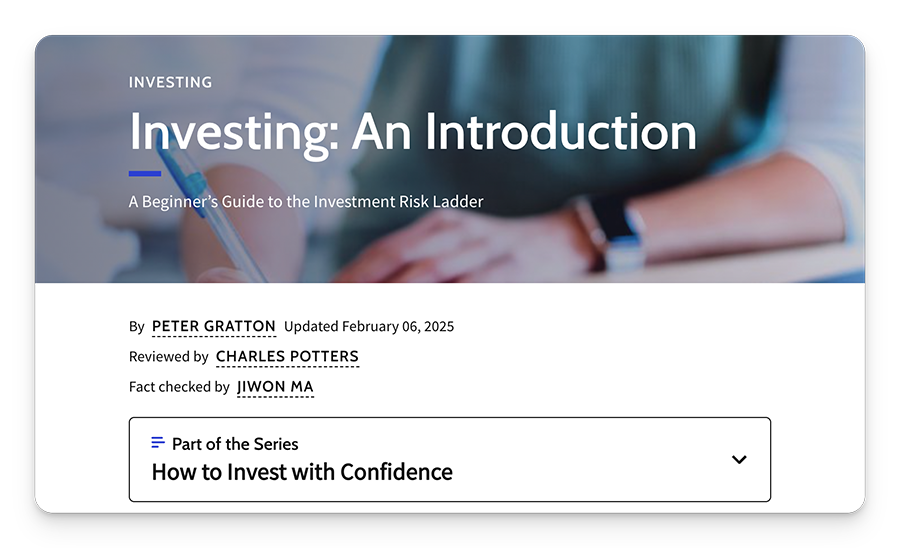
Link to studies, research and credible articles to verify any claims in your content.
Include expert input
Where possible, include expert insights and commentary from established professionals in your field.
For example, if you’re writing a blog about how to use ISAs as an alternative to pensions to save for retirement, you might have quotes from an interview with a professional financial advisor.
This adds credibility and expertise to your content.
Gain backlinks from credible websites
Backlinks from reputable websites are one of the strongest indicators that your content is trusted and valued by others. It works almost like a voting system, with each backlink showing support for your content as a trusted resource.
The more relevant and credible the referring site is, the more value it can provide to your domain, reinforcing your perceived expertise and trustworthiness.
Backlinks from reputable sites in your industry can have a positive impact on your topical authority, too. This is Google’s perception of your authority within a certain industry, niche or singular topic. The more topical authority you possess, the higher you’ll rank in the SERPs.
There are a few ways to earn backlinks. You can focus on creating content that’s valuable, well researched and brings unique insights to a topic, for example, and hope that third parties find it useful to link to in their content.
You can also reach out to relevant third party websites and create connections to encourage backlinks. This could involve:
- Pitching guest posts that add value to their audience while linking naturally back to your content.
- Offering original data, surveys, or industry insights that journalists and bloggers can reference and link to using HARO alternatives.
- Collaborating on joint content like expert roundups, webinars or interviews.
- Identifying broken links on their website and suggesting your content as a replacement (known as broken link building).
- Implementing ‘The Skyscraper Technique’, where you create a resource on your website and ask a third-party to update their existing outgoing link to your page or resource, as it provides better value for their audience.
Need to follow YMYL best practices when publishing content?
We can help increase the credibility of your website with carefully crafted content that aligns with YMYL principles. Start creating YMYL content
How to implement EEAT in your current marketing strategy
Implementing EEAT effectively creates new opportunities to build trust, increase brand visibility and attract high-intent customers.
In this section, we’ll explore marketing opportunities that your business can tap into while developing an EEAT framework.
Content marketing
Your EEAT model will feed into your content marketing strategy. The EEAT standards encourage you to create well-researched articles with unique insights, improving the value of your content. This can include 10x content.
10x content provides 10 times more data, value, insights and EEAT than the content currently available to your audience. This helps position your brand as a trusted authority in your field and increases your visibility.
Link building
Proactive link building is arguably the most difficult and time consuming element of building EEAT for your online content and reputation. Whilst the best, most relevant content will naturally attract reference links from relevant bodies, that isn’t viable if your content isn’t already ranking well.
Algorithms have long favoured relevant links from authoritative third parties, and these are hard to achieve.
Using the 10x model, you can look at the backlinks that the top 10 results have achieved and seek to create similar partnerships with the publishers who have referenced their work.
Alternatively – or in addition to the 10x model – you can find untapped resources as potential backlink opportunities, paving a new path for unique topical authority.
Sticking to the YMYL framework, your content will only reach its full organic potential when authoritative domains are referencing it.
To pre-empt this, research the types of websites that might naturally cite your work in their own content, and start forging relationships to work together.
Let’s say you provide invoicing and cash flow management tools for small businesses, and you’ve published a guide on getting paid faster as a new business.
Google queries that your target audience might search to find your guide, such as “why are my clients paying late?” and “how can I ask my clients to pay faster?”. Assess the SERPs, looking at their products or services and blog content. Could you write their next blog, naturally referencing your own resource?
Of course, a direct competitor wouldn’t be interested in a collaboration, but a website that’s focused on how to start a business or improve business finances might be.
This creates a snowball effect. The more relevant, quality links that you can earn, the higher the content will rank, and ultimately begin to naturally acquire its own backlinks from relevant sources.
Brand awareness campaigns
Brand awareness can help you showcase EEAT while increasing your reach and curating a positive brand image.
Gain brand awareness by hosting webinars, for instance, which provide an excellent opportunity to demonstrate expertise, share first hand experience and build trust with your audience.
Collaborate with expert contributors to highlight your credibility and use their insights across PR and social media campaigns.
Influencer marketing
The global influencer marketing industry is worth around £24 million, making it a key focus of many marketing strategies. It can also be implemented into your EEAT framework, with valuable collaborations helping enhance your business’s image.
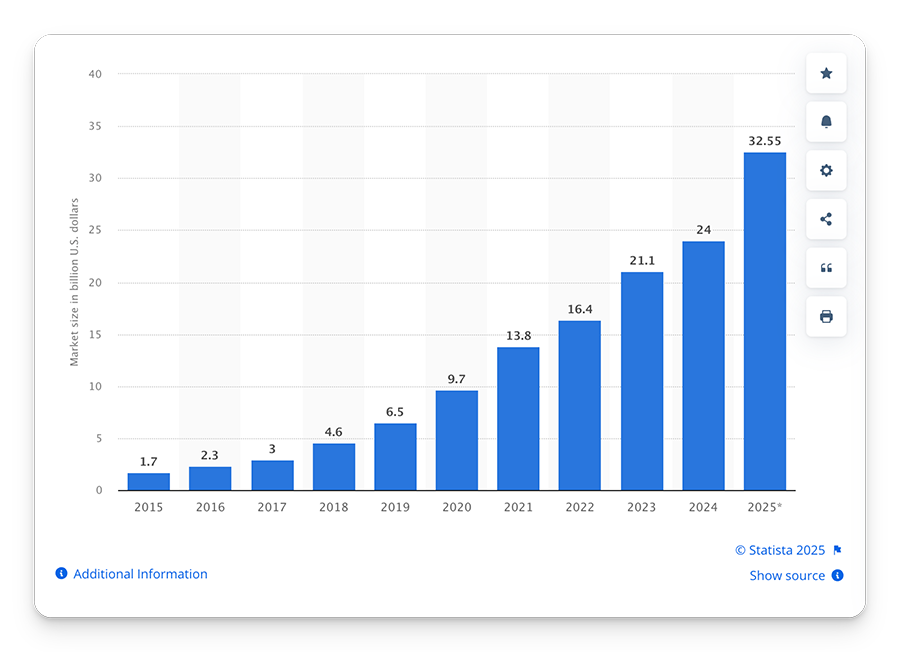
When implementing influencer marketing, ensure you align your partnerships with your brand image and values.
For instance, if your fintech business provides budgeting tools, partnering with a finance content creator who shares money management tips can enhance your credibility.
Their audience already trusts them, and their endorsement of your product reinforces both your expertise and trustworthiness.
Start introducing EEAT into your marketing today
Once you’ve clarified what EEAT is, how it can help you create people first content, and the principles involved, you can begin developing an actionable strategy to improve your website and brand’s EEAT.
Start with steps that align with your business. For example, if you’re producing YMYL content, it might be a priority to partner with experts and establish a system of reviewing content to enhance accuracy.
If you’ve identified EEAT mistakes in your content, such as outdated author bios and a lack of first hand experience, you might implement a plan to review and update your published content based on your EEAT checklist.
Remember, improving EEAT is an ongoing process, not a one-time fix.
Set clear goals, assign responsibilities, and track your progress regularly to ensure your content consistently demonstrates experience, expertise, authoritativeness, and trustworthiness.
EEAT and people first content FAQs
Developing people first content to build your EEAT credibility? To learn more, let’s look at the answers to these FAQs.
The EEAT framework stands for experience, expertise, authoritativeness and trustworthiness. It’s used by Google’s human Quality Raters to analyse content and look for signals that it’s people first, meaning reliable, accurate, and answers the target audience’s questions.
This is closely linked to their push for Helpful Content, which prioritises resources that are useful to Google users.
EEAT signals include content that’s authored by experts, matches search intent and provides valuable insights.
Google stated that EEAT isn’t a direct ranking factor in their guide to Creating Helpful Content
E-E-A-T guidelines remain highly relevant when publishing content. This was highlighted in Google’s March 2025 update, which found that content focused on SEO rather than user value saw significant declines in ranking positions, giving a boost to people-first content.
Google continues to review EEAT content and prioritise authoritative, trustworthy websites when organising SERP.
The key principles of EEAT are to create content that displays experience, expertise, authoritativeness and trustworthiness. By doing so, you’ll publish people-first content that provides your audience with valuable resources to answer their search queries.
Some ways you can implement EEAT principles include link building, publishing client case studies and showcasing author credentials or expert contributions.