Key Takeaways:
1. Effective content strategies increase visibility across search engines, AI Overviews and LLMs.
2. SEO is still essential for visibility. AI search has simply expanded discovery opportunities.
3. Future-proof strategies combine evergreen content, clear KPIs, and continuous optimisation.
The world’s seen a lot of change over the past couple of years, including the exponential rise of artificial intelligence (AI). If you’re feeling a little lost in a sea of LLMs and AI search, we don’t blame you – and you’re definitely not alone.
But when it comes to your content marketing strategy, it doesn’t have to be confusing. With a clear, well-researched strategy and key performance indicators (KPIs) guiding your team, you can create content that works for search, LLMs, and your business.
CMI’s ‘B2B Content and Marketing Trends: Insights for 2026’ surveyed 1,015 B2B marketers and found that 61% of marketing teams report that a clear strategy improves the return on investment (ROI) and effectiveness of their content.
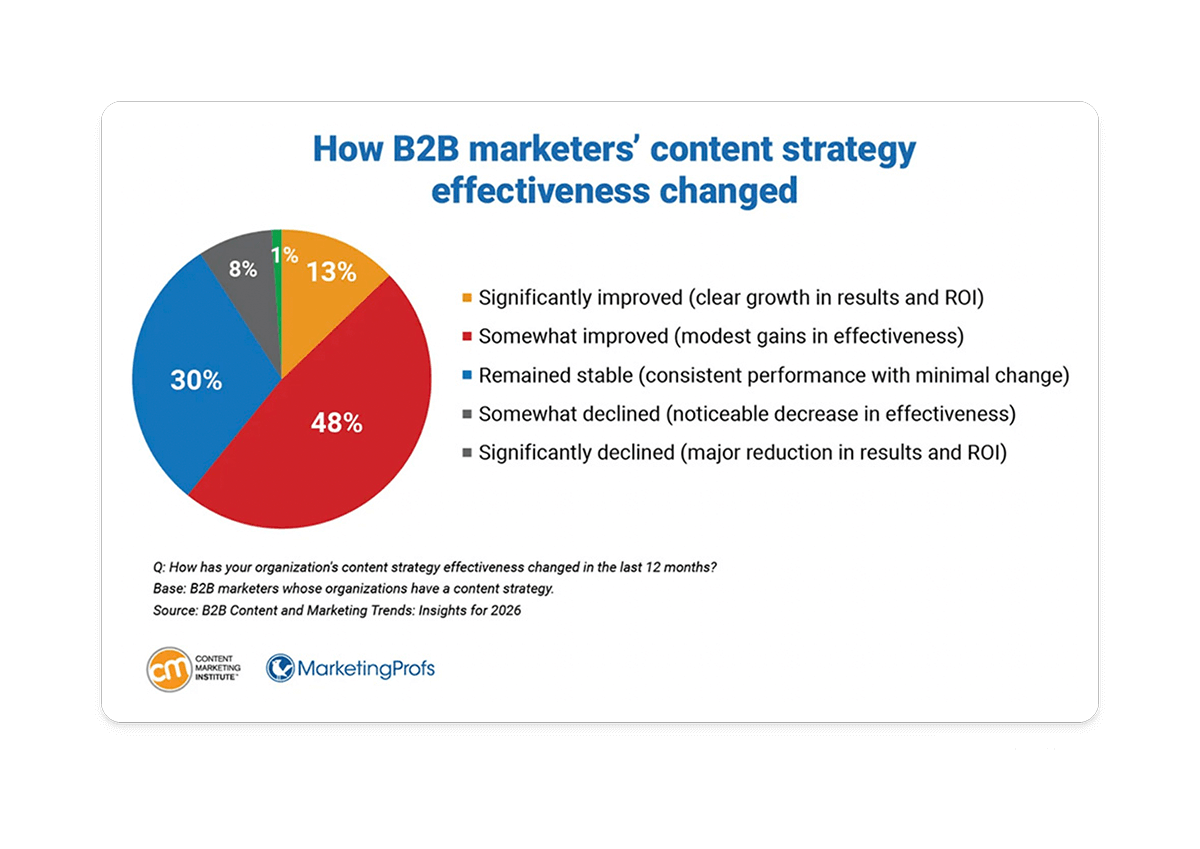
Image source: Content Marketing Institute
It steers campaigns and roots your blogs, videos, and podcasts in data-backed insights, taking the guesswork out of marketing.
In this guide, we’ll look at how you can craft clever content for marketing that boosts both your SEO and LLM visibility. From “what is content marketing?” to a how-to guide on developing your strategy, make your marketing work for your brand with our helpful insights into what your consumers and AI systems want from your content.
We’ll provide you with:
1. Insights into how AI and LLMs should be considered in content marketing strategies.
2. A how-to guide to creating a content marketing strategy.
3. Tips and techniques for creating, distributing, and optimising your content.
What is a content strategy?
A content marketing strategy is a detailed plan of how you’ll create, publish, and manage content. Starting with research to build a roadmap that’s tailored to your niche, target audience, and business goals.
A strong content strategy for search and LLMs includes:
- Audience research: who you’re speaking to and what they care about.
- Content goals: what you want your content to achieve.
- Content formats and channels: where and how you’ll share your message.
- Keyword and topic research: the subjects your audience searches for.
- Brand messaging and tone of voice (TOV): how your brand communicates its mission and offering.
- Publishing cadence: when and how often you publish content.
- Measurement framework: how you’ll track success and adjust over time.
Your content strategy should be constantly evolving based on new insights.
We’ll share a step-by-step breakdown of exactly how to develop a content marketing strategy specifically for search and LLMs later in this article.
But first, it’s important to understand the benefits of a content marketing strategy and why you should consider SEO and LLMs together.
How do content strategies need to evolve for AI-driven discovery?
An important part of any content strategy is visibility. You want your content to reach as many people as possible, or it’s simply not going to bring you the results you’re looking for.
This is where understanding SEO and large language models (LLMs) is crucial.
- SEO is the process of improving your content so that it ranks well for relevant queries on search engines like Google. When using content for marketing, SEO helps you reach more high-quality leads.
- LLMs are AI systems that can understand and generate text, like ChatGPT and Copilot. Users can have full conversations with LLMs, using them to answer questions or find solutions.
LLMs haven’t replaced traditional SEO; they’ve expanded how your content can appear. LLMs aren’t generating anything that the search engines aren’t, but are pulling insights from online sources to answer user queries in a new, conversational way.
Meaning that brands with strong content marketing strategies can outperform competitors in more places than ever before, provided their content is both search-ready and LLM-ready.
Search engines and LLMs don’t read your content in the same way. If you want your brand to perform in both the SERPs and AI-generated answers, you need to know what each system looks for.
Here’s a clear comparison to guide your content strategy for search and LLMs:
| Feature | Traditional Search (Google, Bing) | LLMs (ChatGPT, Gemini) |
|---|---|---|
How content is understood |
|
|
What they prioritise |
|
|
What they extract |
|
|
Signals they trust most |
|
|
Opportunities for brands |
|
|
McKinsey’s Growth, Marketing & Sales Practice team found that around 50% of consumers are tapping into AI-powered search, presenting an entirely new way for brands to reach leads. This is expected to rise to more than 75% by 2028, according to trend analysis from McKinsey. Exciting stuff.
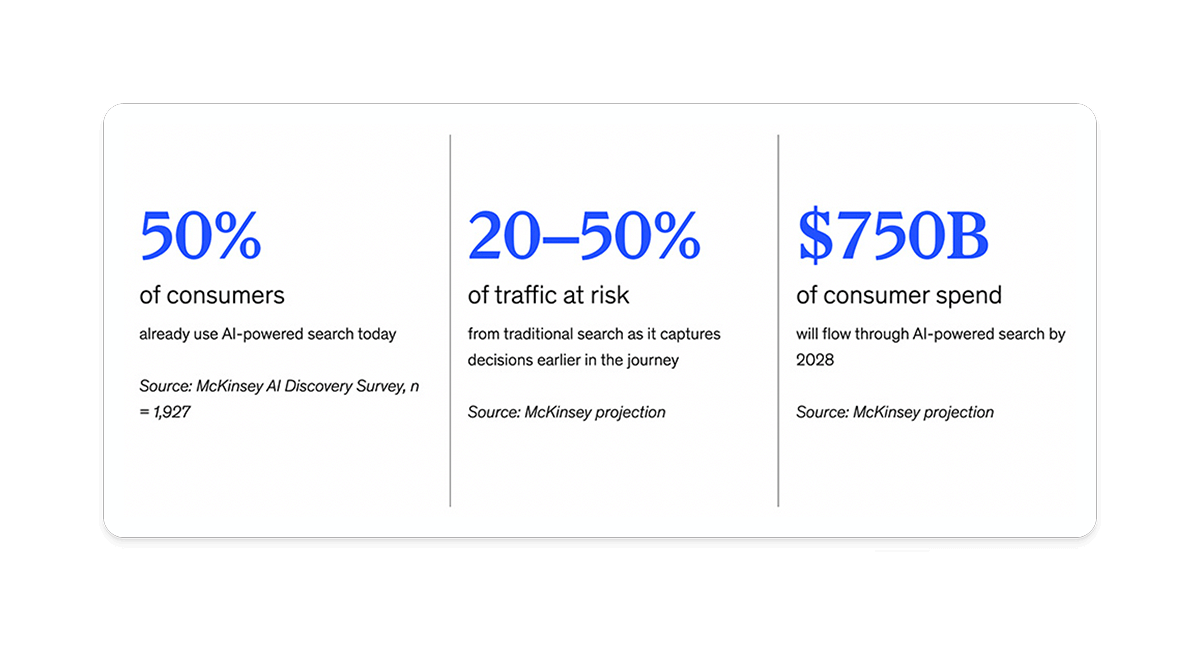
Image Source: McKinsey
This leads us to the topic of AEO.
What is AEO?
AEO (Answer Engine Optimisation) is similar to SEO, but rather than optimising your content to suit Google algorithms, you’ll be focused on AI overviews and LLMs.
The tricky part? SEO and AEO don’t always overlap. The results for one keyword prompt in Google will differ from the way a user asks ChatGPT or Gemini, for example.
Search now delivers different answers for the same query
To compare, we searched “What is the best tool to check backlinks?” across the 3 major LLM platforms (ChatGPT, Comet by Perplexity and AI Overviews) as well as traditional search (Google) to see how each platform responds to the same query.
What we found shows a major shift in how information is presented to users. Below, we’ve included the screenshots to show how each platform responded and how differently they identify “the best” backlink tools.
Traditional search engine results page (SERP):
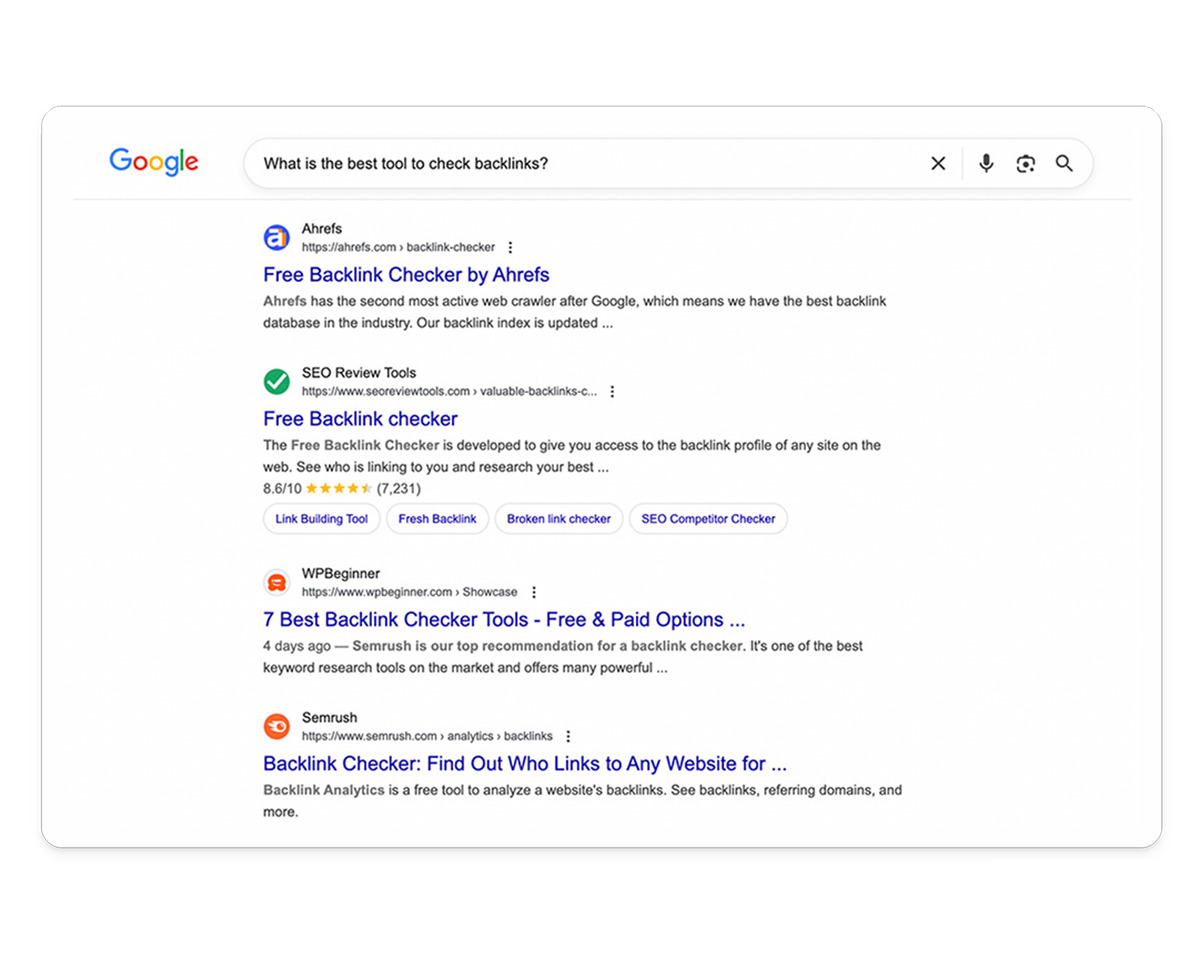
⚡ Traditional search engines prioritise relevance, keyword signals, and long-established authority.
AI Overviews response:
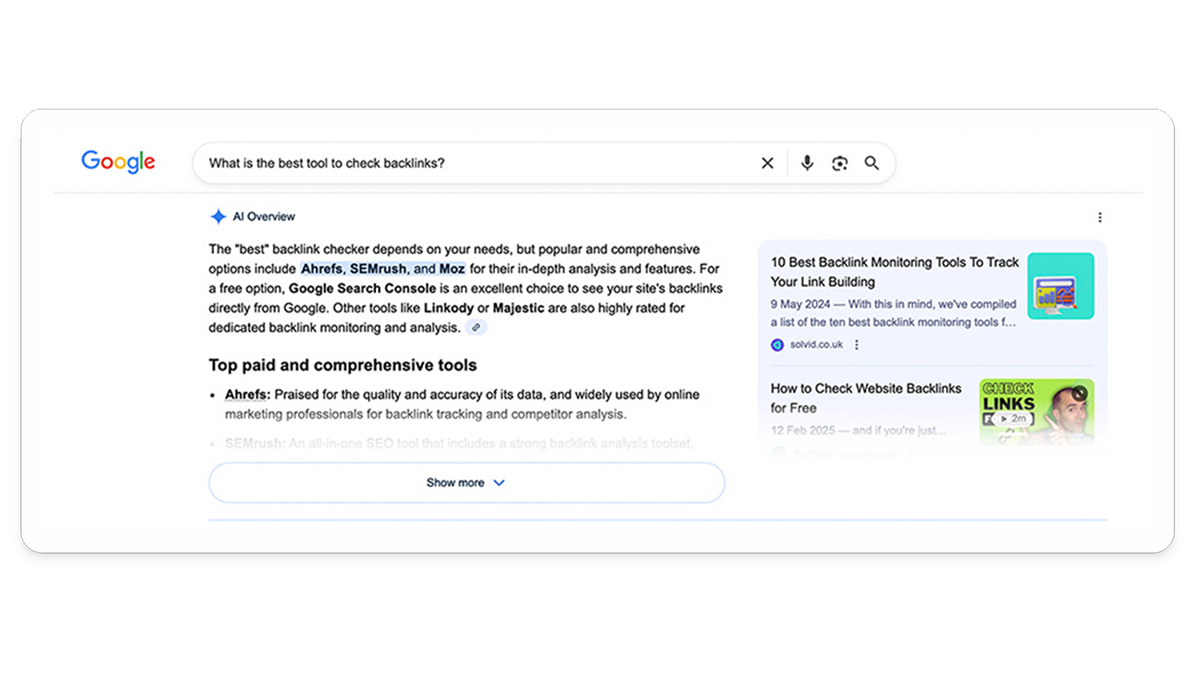
⚡ AI Overviews blend multiple trusted sources into a concise summary without selecting a single “best” tool.
ChatGPT reply:
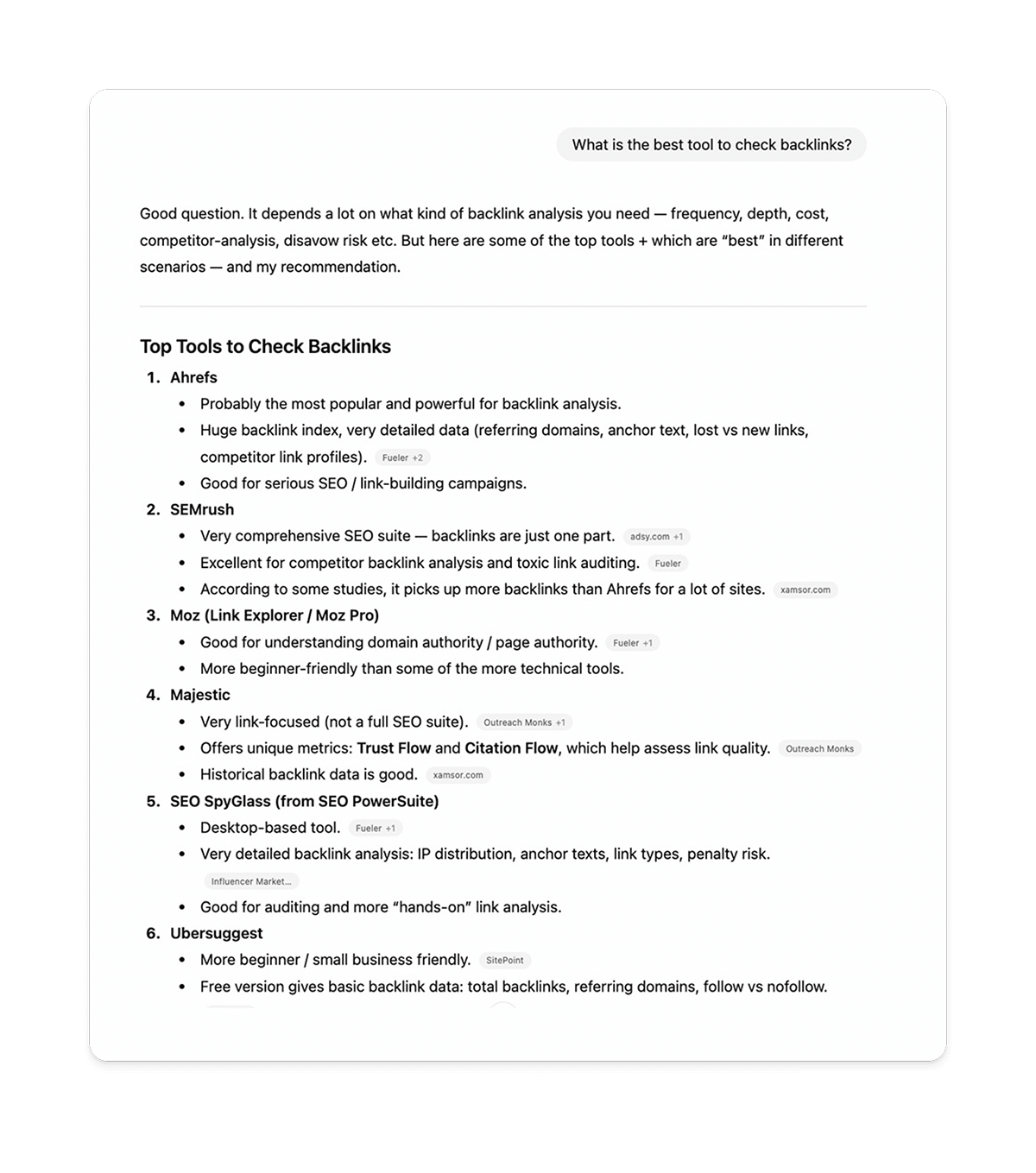
⚡ LLMs, like ChatGPT, generate an answer based on clarity, structure, expertise, and heavily factoring in external reviews of each provider. It includes who each tool is most suited to based on the brand’s positioning in the market.
Comet (Perplexity browser) response:
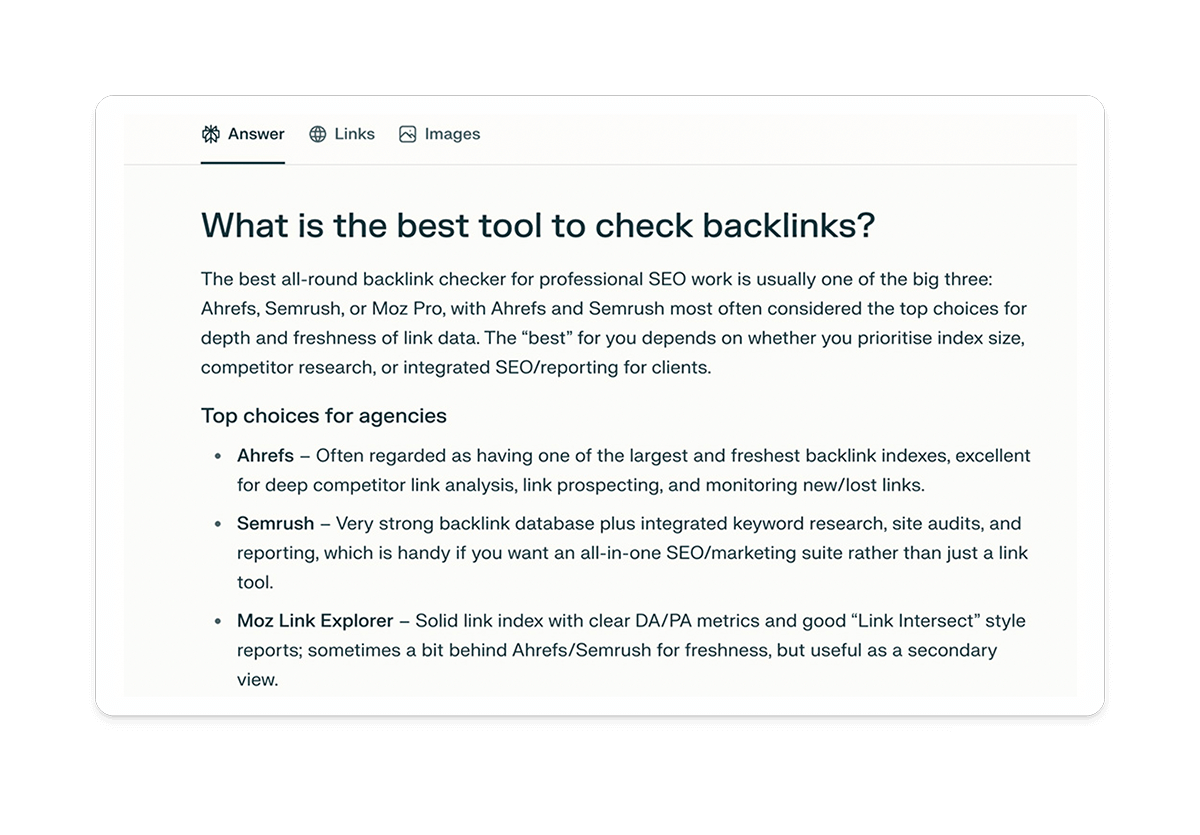
⚡ Perplexity’s browser cross-references live sources and present evidence-backed citations.
Even though the question is identical, each search platform provides a slightly different result. This shows exactly how fragmented the discovery landscape has become.
Google rewards established SEO signals. AI Overviews synthesise several “trusted” sources. ChatGPT generates an explanation based on clarity and expertise. Perplexity cites the most precise, structured insights it can identify.
For marketers and brands looking to level up your content strategy, you need to perform across multiple search environments:
1. Rank in the SERPs.
2. Be quotable for LLMs.
3. Be authoritative enough to appear in AI Overviews.
Get to know your AI visibility.
Use our AI visibility checker to see how your website’s performing in AI search and across LLMs, identifying gaps that your content marketing can improve. Start an AI visibility check
What are the benefits of a content marketing strategy?
Being honest, content marketing isn’t easy. It’s a long-term strategy that requires a whole lot of patience, hard work, and consistency. So why do it? Because when executed well, a content marketing strategy can deliver powerful, sustainable results when looking to grow a brand or business.
The benefits we’ll cover in this section include:
- Building trust and authority
- 24/7 marketing
- Streamlines content creation
- Organic visibility growth
- Lead generation
Let’s take a look at the benefits of content marketing in a bit more detail to learn more.
Builds trust and authority
Brands that consistently publish transparent, clear content become the sort of businesses that consumers rely on and that AI search platforms source.
In the 2025 Edelman Trust Barometer: “Brand Trust, From We to Me”, surveyed 15,000+ respondents across 15 countries to find out what it takes to be a trusted brand today.
Edelman’s research found that 76% of UK consumers trust the brands they shop with more than they trust either the media or the government, showing just how vital trust and credibility are in influencing buying decisions.
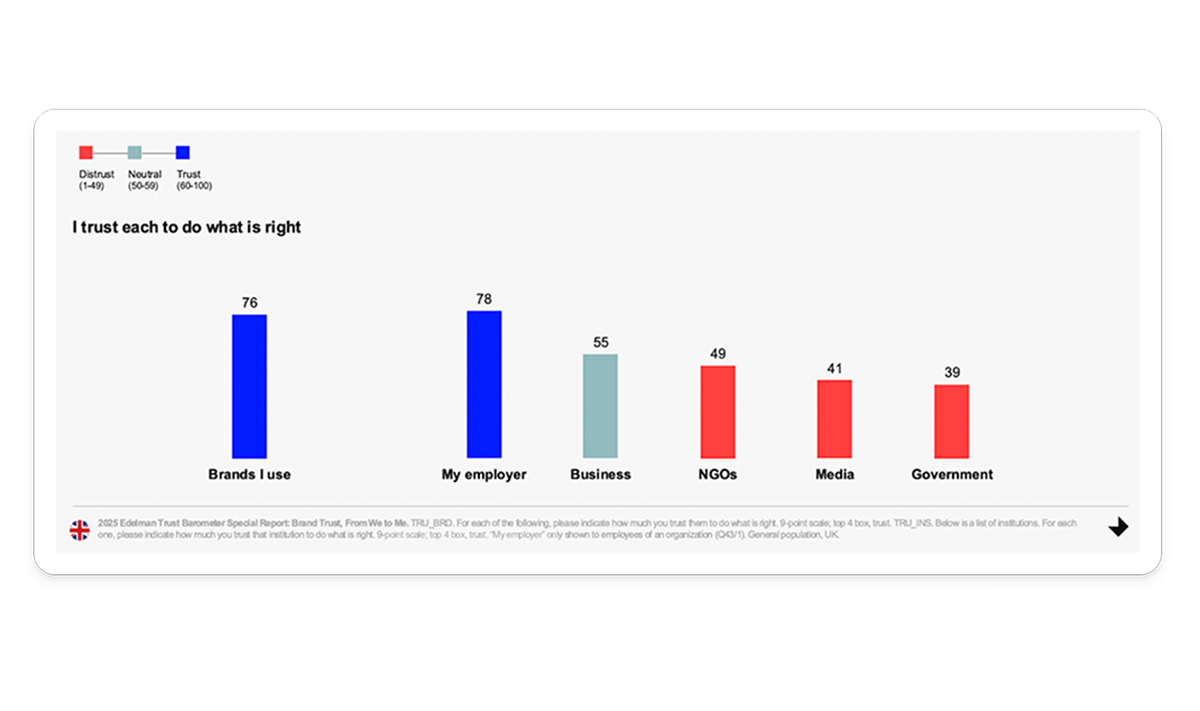
Image Source: Edelman Trust Barometer
Trust has become a primary decision-making filter, impacting how people choose what to read, who to buy from, and which businesses they recommend.
Why trust directly impacts search and LLM visibility?
It’s not just consumers that value trust. Google continues to prioritise authenticity, as proven by their Helpful Content Update.
These guidelines shed insight on how the world’s most popular search engine ranks websites – and trust is a central factor.
Google’s E-E-A-T guidelines highlight four core signals:
- Experience
- Expertise
- Authoritativeness
- Trustworthiness
These guidelines can also be applied to how LLMs understand, summarise, and cite brand information. If your content isn’t trusted, it’s not used – by Google, by LLMs, or by your target audience.
In short? Gaining trust and building contextual authority should be a major part of your marketing, and a quality content strategy is a sure-fire way to help you gain in.
Want to build relevant authority for your brand?
Relevant link building is our core offering at Hive19. Outsourcing can save you time while benefiting from in-house expertise to secure powerful backlinks and coverage. Get started with a quote
How can content help showcase EEAT?
Content offers you an opportunity to showcase your expertise. Use it to demonstrate first-hand experience and relevance to common problems your customers are looking to solve. This can be done in lots of ways, including:
- In-depth guides.
- Clear explanations of complex topics.
- Practical frameworks and walkthroughs.
- How-to videos, checklists, and real-world examples.
- Case studies that demonstrate tangible outcomes.
Example: If your business provides payment software for small businesses, you could publish content that simplifies complex topics, like PCI DSS compliance, reducing payment failures, or improving cash flow forecasting. Real scenarios help potential buyers see that not only do you have a deep understanding of their personal challenges, but that you can actually offer a solution to make their lives easier.
This is the kind of content LLMs reference, include source links to, and summarise on their platforms because it has contextual authority. Over time, this helps build trust in your product and your brand across all discovery channels – traditional and AI search.
Alongside informative content, your content marketing strategy should communicate clear trust indicators that reinforce your credibility across all discovery channels. These might include:
- Certifications and credentials
- Industry awards
- Case studies
- Client testimonials
- Verified data sources
- Author bios and editorial policies
All of which are essential for building trust within your industry.
When you consistently create informative, accurate, and people-first content, you provide reassurance to your target audience. They can see that your brand doesn’t just sell a product; you really understand them, the industry, and your place in the wider business landscape.
This is exactly why trust and authority should be core pillars of your content marketing strategy for both search engines and LLMs. The brands that win are the ones LLMs and customers are confident turning to for reliable answers.
Does Google trust your content?
At Hive19, we can help you align your content with Google’s latest updates, including EEAT and helpful content. Download our Helpful Content Checklist
Round-the-clock marketing
A strong content marketing strategy works for your business 24/7. When done correctly, quality content delivers value long after you publish it, rather than a one-time quick fix and a short burst of visibility. This is especially true for evergreen content.
Evergreen articles, guides, and resources remain helpful and relevant over time. (rather than time-sensitive or trend-based content). By developing a clear strategy that focuses on evergreen topics, you create assets that consistently attract traffic, appear in search results, and show up in LLM responses without the need for constant updates.
LLMs often reference factual, practical and helpful content when generating responses. If your content meets those standards, it’s more likely to be cited or summarised in AI search.
Pretty powerful, right?
At Hive19, we’ve seen evergreen content deliver increased visibility for clients and continue driving conversions years after it was first published. It’s a clear indicator of the long-term impact and ROI that effective content marketing strategies can achieve when the focus is on building a strategy that works for you around the clock. Positive results are possible when your content is planned with intention, backed by data insights and executed properly.

“Hive19’s dedication to producing content that meets and often exceeds expectations is admirable. Their writers display a deep understanding of the subject matter and a skill for engaging storytelling and research, making each piece informative and problem-solving.
I advocate Hive19 as a content agency that sets the industry standard for professionalism, engagement, and content quality. Working with Hive19 has been a truly rewarding experience, and I look forward to our continued collaboration.’
In conclusion, Hive19 are the best organised partner we’ve ever worked with.”
– Marta Mazurowska, Content Manager at SumUp
Streamlines content creation
Content marketing planning isn’t just useful for producing better quality content. A strong strategy aligns your entire team and streamlines workflows, bringing organisation to omnichannel marketing.
With standardised processes, cohesive goals, and a clear roadmap, you ensure everyone’s moving in the same direction with a common goal. Workflow becomes faster and smarter, with less stress involved to reach key content milestones. Say goodbye to bottlenecks and hello to uber-organised marketing!
A well-developed strategy is also useful for staying ahead of changes, like the arrival of LLMs and AI overviews. As search continues to evolve, having a clear, flexible strategy means you can adapt quickly, fine-tuning your content to meet both audience needs and algorithm shifts.
Real-world example: Hive19
This is something we continuously do as part of our own content marketing strategy at Hive19. Let’s take a look at an example of where we’ve seen great success.
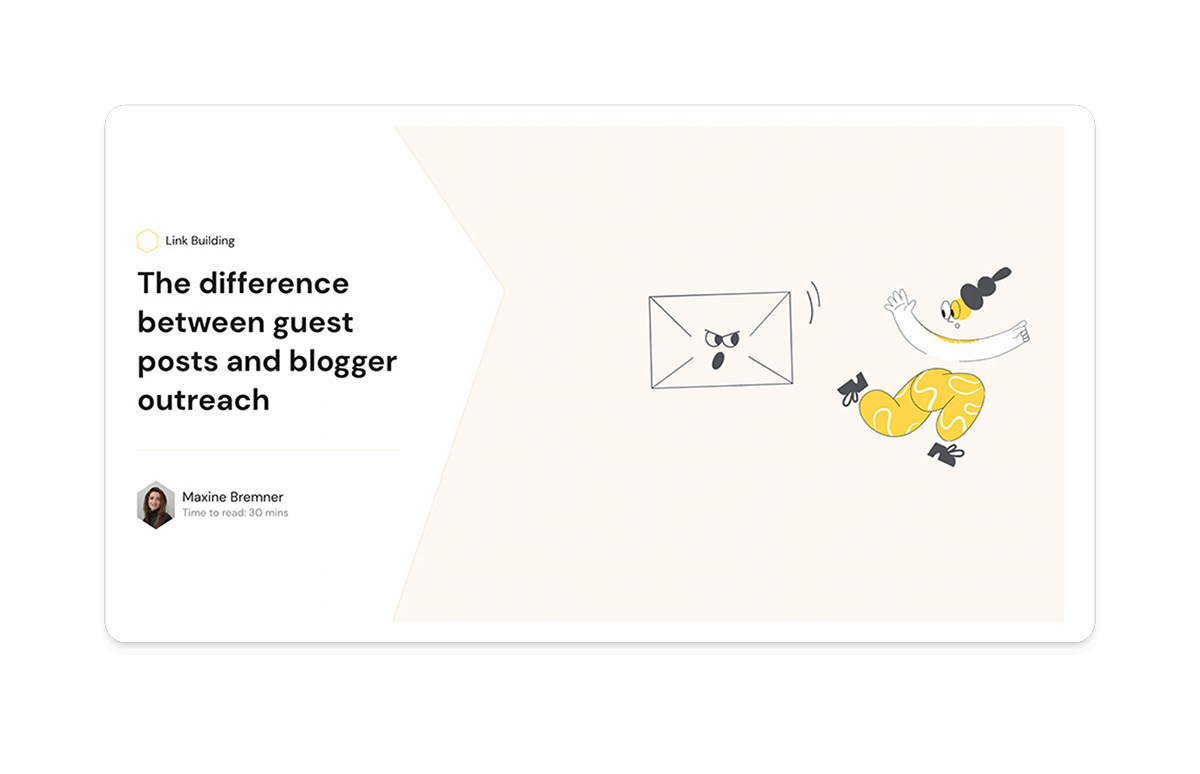
Blog: The Difference Between Guest Posts and Blogger Outreach.
Published: July 2025.
Initial strategy: Spend the first 2 months promoting across various channels, tracking the performance.
Optimisation phase: In month 3, we decided to freshen up the content and optimise it for AI Search and LLMs. This included more unique insights, verified data sources, visual comparison tables, custom graphics, rich media assets, and expert quotes from our team and external industry experts.
Results after 5 months:

- Ranking 1st page for competitive key terms such as “blogger outreach” and “guest post outreach”.
- Consistent organic traffic of more than 100 visits per month.
- We appear in Google’s AI Overview and Perplexity for relevant answer queries and summaries.
- Hive19’s blog is used as a consistent source to answer questions in ChatGPT, such as “What is guest outreach?” and “What’s the difference between blogger outreach and guest posting?”
This is a great example of how a clear content marketing strategy, supported by ongoing optimisation and improvement (backed by data), can increase your brand’s visibility across search and LLM platforms while building long-term EEAT.
Work with creators trusted by global brands.
Our specialist writers create content that’s focused on brand visibility and growth in search and LLMs. Get a quote for copywriting
Drives organic visibility
An effective content marketing strategy drives organic visibility in a range of ways. These include:
- Keywords: Part of the research to develop your strategy will include looking into the keywords that contribute to search engine optimisation (SEO) and answer engine optimisation (AEO) – more on both of those later.
By using keywords, you help search engines and AI systems to better understand your content and rank it for relevant queries, driving organic visibility. - Backlinks: Excellent content earns backlinks. These are links from other websites to your content, and they signal to search engines and LLMs that your content is trusted, valuable, and authoritative. High-quality content with unique insights earns backlinks from websites with high domain authorities (DAs), which in turn boosts your DA.
It’s a strategy that’s essential for both SEO and AEO, increasing your likelihood of reaching those top search positions and being cited in AI overviews. - Topical authority: Consistently publishing quality content will increase your topical authority. This is your perceived expertise in your industry, and a key trust signal to search engines and AI systems.
By building your topical authority, you make it easier for Google to understand your area of expertise and for LLMs to confidently use your content as a source for overviews and user queries. It helps you rank better for relevant keywords and appear in a wider range of search results.
In marketing, content isn’t just about writing up a blog or shooting a quick TikTok and chucking it out there. It’s technical and strategic.
If you want to see a significant increase in your organic visibility, leads, and conversions, you need a strong content marketing plan to capture intent-based keywords, attract natural backlinks, and boost topical authority
We also recommend doing a backlink analysis to identify which content earns you the most links from sites with high DA.
Improves lead generation
If you’re looking to increase brand visibility and generate more leads, creating an effective content marketing strategy is a brilliant place to start.
With so much content already competing for attention across social media, search engines, and now LLMs, we’re seeing many brands feeling unsure about whether their content is still being surfaced where their audience is actually searching.
A well-planned strategy ensures your content rises above the noise and reaches exactly who matters most – your target customer.
This is true across every stage of the marketing funnel, from generating Top of Funnel (ToFu) awareness to driving Bottom of Funnel (BoFu) conversions.
The brands performing best today are the ones using a content strategy to close the gaps across all search channels. Aligning your content with the questions people now ask using AI platforms and LLMs will help your content stay visible in both traditional and newer discovery platforms (Google’s AI Mode and AI Overviews, ChatGPT, Perplexity, Copilot, etc.)
A strong content strategy has a big impact on brand awareness and ROI. With a clear direction backed by data insights and market research, you can focus on producing content solutions that you know drive results, rather than relying on guesswork or past performance from a time when traditional search was the only channel that mattered.
Your customers can now find you in organic search, social media, AI discovery, and LLMs. So, you need to consider not only how your content is understood by search engines, but how LLMs interpret it too. This includes:
- Structuring information clearly.
- Answering questions directly.
- Producing content with genuine expertise.
When these fundamentals are successfully implemented into your content strategy, your brand is more likely to appear in AI-generated responses, and you’ll have a stronger chance of converting prospective buyers when their intent is high.
How to create a content strategy (step-by-step)
Creating a content marketing strategy can skyrocket your business growth, and it’s how we organise and schedule our workflow whilst remaining consistently visible for competitive keywords and high intent search queries.
Developing your content marketing plan, though, can be tricky.
To guide your next moves, we’ve created a how-to guide and will go into our proven strategy for content marketing success:
1. Set clear goals and KPIs
2. Understand your audience
3. Conduct a competitor analysis & content audit
4. Create helpful and AI-friendly content
5. Use content scheduling tools
6. Promote, distribute, and measure performance
Use this as a content strategy template or as inspiration for your own unique roadmap.
Step 1: Set clear goals and KPIs
What are you hoping to achieve by developing a content strategy?
Defining your goals is the foundation of an effective content strategy. Clear objectives guide your decision-making, shape your roadmap, and help you determine which metrics truly matter. Whether you’re building your first content strategy or refining an existing one, goal-setting keeps your content focused, purposeful and supports both search performance and AI-driven discovery.
Use the SMART framework to define goals
We recommend using the SMART framework, ensuring your goals are:
Specific
Measurable
Achievable
Relevant
Time-bound
Example: If you offer CRM software, a SMART goal could be:
“Rank on page one for ‘CRM for IT businesses’ within 5 months and appear in AI Overview or LLM answers for intent-based queries such as ‘best CRM for IT teams’.”
You then need to align your content with this goal, looking at ways you can tie it into search engine optimisation (SEO) and LLMO (large language model optimisation).
When looking at content marketing examples, a strong method to achieve this would be through a hub and spoke content model.
Using the hub and spoke model for content marketing
The hub and spoke model is where you have a single, comprehensive hub page, that covers one broad topic. The spokes relate to the supporting subtopics relevant to that wider topic, but offers more in-depth value. Each spoke links back to the hub, and the hub links to each spoke.
A hub and spoke content models helps search engines and LLMs understand your topical authority niche and improves content discoverability across various discovery environments, and makes it easier for users to navigate related topics on your site.
Going back to our example of a CRM platform, you might have a guide on ‘The Complete Guide to CRM for IT Businesses’.
Your spoke content would feed into this blog, looking at other specific subtopics or queries that are related to the main hub topic.
These could be articles on:
- How to choose the right CRM features for IT teams.
- Security and compliance considerations for IT-focused CRMs.
- Common CRM implementation challenges in IT teams (and how to solve them).
- How to integrate a CRM with existing IT infrastructure.
These spoke content marketing ideas work because they cover multiple intent types: informational, advisory, comparison, and problem-solution and target long-tail queries that LLMs often pull into conversational answers.
Each spoke article links back to the main hub page and vice versa. This interlinked structures helps search engines and LLMs understand that you have a deeper level of expertise, improving your topical relevance so that your content performs better in the SERPs for related queries.
The goal is to signal to search engines and AI platforms a clear signal that your brand is the one place that audiences can go for the entire “CRM for IT” topic cluster.
Have you checked your website’s authority recently?
Check how your marketing is going and where you need to improve, or take a sneak peek at the authority of your competitors. Check any domain
Understanding which KPIs to focus on
For a successful content marketing strategy for search and LLMs, it’s important you have key performance indicators (KPIs) in place to monitor your progress towards goals. These are the metrics that show whether your strategy is working or not.
If you’re hoping to improve brand awareness, you need to be tracking social media followers, social mentions, share of voice, branded search and direct website traffic.
Developing specific goals and KPIs establishes solid foundations for growth, right from the get-go. It gives your content strategy a clear direction that aligns with your wider business aims.
10 tools that help you track and monitor your KPIs
When setting goals and measuring your KPIs, the tools our team uses that are super useful include:
Website traffic and performance:

- Google Analytics (GA4): Tracks user behaviour, engagement and conversions so you can see which pages are performing.
- Google Search Console (GSC): Shows how your site performs in Google search, including impressions, clicks and keyword visibility.
- Hotjar: Explore how users interact with your pages through heatmaps to highlight UX issues.
SEO and keyword performance:

- Semrush: Get keyword, competitor and backlink insights to understand what drives organic visibility.
- Ahrefs: Find content gaps and look into your backlink profile to find opportunities to support SEO growth and backlink building.
- Keywords Everywhere: Access keyword insights directly in your browser to speed up research and content planning.
Marketing automation and lead tracking:

- HubSpot: Tracks leads from Tofu to Bofu, giving full visibility of how content influences your pipeline and lead generation.
- Marketo: Automates lead nurturing and scoring so you can measure how your content helps move prospects through the funnel.
- Ruler Analytics: Connects content activity to revenue by attributing leads and conversions back to individual touchpoints.
AI Visibility:

- LLMrefs: Track when and where your content appears in LLM responses and AI Overviews, helping you track AI-driven discoverability.
Step 2: Understand your audience
Getting to know your target audience on a deeper level guides your content strategy. It ensures that everything from your visuals to your tone of voice (TOV) appeals to your potential customers, which is essential for the success of your marketing.
Start by building data-backed customer personas. This is a detailed profile of your typical customer, and will identify key characteristics and behaviours like:
- Age
- Gender
- Location
- Hobbies and interests
- Income
- Purchase intention
- Pain point
⚡ Expert tip: HubSpot has an excellent Make My Persona Generator, which uses demographics, behaviors, goals, and pain points to create to build a detail persona that can inform your content marketing strategy.
AI tools like ChatGPT and Claude are useful here, compiling a multitude of online research to give you key insights into your target market and content strategy examples. Combine this research method with your own data.
For instance, if you can see that most of your SaaS customers are female millennials from the UK, try a prompt like:
‘Act as a SaaS marketing strategist. Based on current trends, describe UK female millennials who buy SaaS products for personal and professional use. Include their typical job roles, decision making process, main pain points, preferred social platforms, search behaviour, and the types of content formats and topics they are most likely to trust and engage with at each stage of the funnel. Suggest content ideas and angles that they’re most likely to consume.’
⚡ Expert tip: When using LLMs, the more context and detail you provide, the better the output will be. Be as specific as possible about your audience, goals, channels and challenges. What you put into a prompt directly shapes the quality, depth and relevance of the answer you get back.
You can also learn more about your target audience by speaking to them directly. Ask questions via social media polls, surveys, and in-person interviews, for instance, to gain a deeper understanding of who you’re marketing to.
AI tools are a great place to start for building customer personas, but nothing replaces primary research. LLMs can only reflect what already exists online, while your customers can tell you what isn’t documented anywhere. Speaking directly to your target customers and asking questions through social media polls, surveys, and in-person interviews you get real-world pain points, motivations and needs from the horse’s mouth, that AI alone can’t provide.
As well as creating your target customer profile, look at how your customers move throughout their buyer’s journey. What steps do they take that move them from awareness (Tofu) to consideration to a conversion (Bofu)? How many interactions does it take before a conversion? Where do most leads drop off in the marketing funnel?
Use this to shape your content strategy so that it mirrors how your target audience searches, discovers brands and make purchase decisions across search and LLMs.
Example: If you know that awareness is generated through social media, your content here should focus on education and informing, while guiding users towards the next step (consideration – think case studies and product demos).
Use data on where your leads are dropping off to resolve any potential points of friction and improve the flow of your marketing funnel with clear call-to-actions (CTAs) and incentives.
Audience Segmentation
It’s likely that you won’t have a one-size-fits-all customer persona. This is where audience segmentation comes in, and it’s a must for personalising your content marketing strategy.
Audience segmentation involves breaking down your larger target market into smaller groups based on key similarities.
Example: If you provide accounting software, you might have two clear customers within your audience: those purchasing on behalf of a business and those purchasing for themselves, such as a sole trader.
Each audience group will respond to and look for different content. Those purchasing on behalf of a business, might want content that highlights multi-user capabilities and the ability to scale with ease.
Customers purchasing for themselves could be looking for software that’s easy to use, connects to their bank account, and offers different subscription models to suit different budgets.
Personalise your content using segmentation to ensure you’re not appealing to your entire customer base.
What problems are you solving for your audience?
Your content should directly address your audience’s pain points. You want to show them that you’re a solution, and that you understand what they need from a products or services.
Let’s say you’ve developed a B2C Fintech app to help people save for a mortgage. If your target audience includes those who struggle to build a deposit there are a number of different pain points you can identify and address within your content strategy, including:
Pain point 1:
Finding it hard to save.
Content strategy: Create a practical content series around budgeting, spending habits and saving frameworks. Focus on realistic guidance for those who might not have a huge amount of wiggle room after their bills are paid, by sharing expert advice on how to make small but consistent progress.
Pain point 2:
Not knowing their mortgage options.
Content strategy: A comparison page that compares different deposit options, including 5% mortgages and helping hand schemes. This is a great opportunity to show off your industry knowledge while helping your target market.
Pain point 3:
Feeling discouraged.
Content strategy: Share case studies of clients you’ve helped who are in similar situations, highlighting clearly how your app helped them stay motivated, track progress and reach their savings goals.
A focused content plan builds trust and ensures you’re appealing to the right market. By empathising with pain points and providing practical solutions, you’re gently persuading your potential customers that you’re the right brand for their needs.
Step 3: Conduct a competitor analysis and content audit
Before creating new content, it’s essential to understand where you currently stand in search and LLM discovery platforms. Also, where your competitors might be winning.
We recommend splitting this step into two: a competitor analysis and content audit.
Competitor analysis
Knowing what your competitors are doing gives you insights into the content that works and how you can differentiate your marketing from similar brands.
Start by analysing your top competitors using tools like SEMrush and Ahrefs to identify their:
- Top-performing content: Look at topics, formats, and other key features that could be boosting performance.
- Backlink profiles: Who’s linking to them and why?
- Keyword strengths and gaps: Search terms they dominate vs. those they miss out on.
It’s useful to organise your research in a comparison table like the following:
| Feature | Competitor | Top performing content | Content strengths | Content weaknesses | Search rankings |
|---|---|---|---|---|---|
|
Example competitor |
Identify the content that’s working well for them. |
Where are they demonstrating the strongest performance? |
Where might they not be seeing results? |
What keywords are they ranking for? |
It’s also a good idea to go beyond traditional SEO and explore which competitors are frequently being chosen to appear in LLM answers and AI overviews for search queries.
Tools like LLMrefs can help you identify the competitors who are nailing AI visibility, as well as Hive19’s AI visibility checker.
10x content that outperforms competitors in search and LLMs
Once you understand what your competitors are publishing, the next step is to create content that is more valuable, more helpful and trustworthy. This is where a 10x content strategy comes in.
What is the 10x content strategy? The 10x framework is where you create content addressing a specific topic that is 10 times better than what’s currently available online and in your industry.
10x content consistently performs well because it goes deeper than generic articles that are rehashing what’s already out there for audiences. 10x content strategy includes fresher research, your unique perspective and first-hand expertise, links out to high authority sources and research and clear real-world evidence that audiences can’t help but trust.
It communicates strong E-E-A-T to Google and makes your content easier for LLMs to pick up and feel confident in pulling into answer summaries, citations and recommendations.
As a result, your 10x content will attract more traffic to your website through higher rankings in SERPs for target keywords, establish yourself as a thought leader in your industry, compete with bigger names in your industry and provide real value to your target market.
Struggling to outperform competitors in search and AI platforms?
Hive19’s 10x content process helps you outperform competitors and build niche authority in search and LLMs. Get started with 10x content creation
Content audit
If you’ve already published content, it’s time for an audit. A content audit is a detailed analysis of all the content created so far and published on your website, where you’ll look at what’s worked for you and what needs improving.
Example: If you’re a SaaS company offering project management software, your content audit might reveal that:
- Evergreen ‘how-to’ articles on collaboration and productivity generate more steady organic traffic than trend-based posts.
- Outdated feature guides and onboarding content quickly lose rankings when not updated after product releases.
- LinkedIn case studies and customer success stories drive more qualified traffic than short-form social videos.
- YouTube tutorials and product walkthroughs attract higher engagement and conversions than TikTok clips.
These data-driven insights ensure you know where to focus your energy when refining your content marketing strategy. Make sure you’re auditing against your KPIs, search rankings, and AI answer inclusion frequency for a comprehensive audit.
⚡ Expert tip: Alongside a content audit, it’s helpful to understand what backlinks are pointing to your website to ensure a full picture of brand authority and opportunity gaps. Check out Hive19’s guide to conducting a backlink audit.
Step 4: Create helpful and AI-friendly content
SEO isn’t just about keywords. To rank well, you need to focus on high-value, quality content that aligns with Google’s Helpful Content and E-E-A-T guidelines.
This prioritises content that:
- Is written or reviewed by an expert.
- Provides original insights or analysis.
- Includes unique statistics.
- Draws on other sources without simply rewriting.
We also recommend adhering to SEO best practices, for example, including meta descriptions, H tags, contextual internal links, and schema.
How to write content that’s cited by LLMs
SEO isn’t just beneficial for ranking in the search engine results pages (SERPs), but also for being cited in AI and LLM overviews. A study conducted by Ahrefs showed that 76% of AI overview citations are also in the top 10 results, showing just how closely traditional SEO and AEO are currently linked.
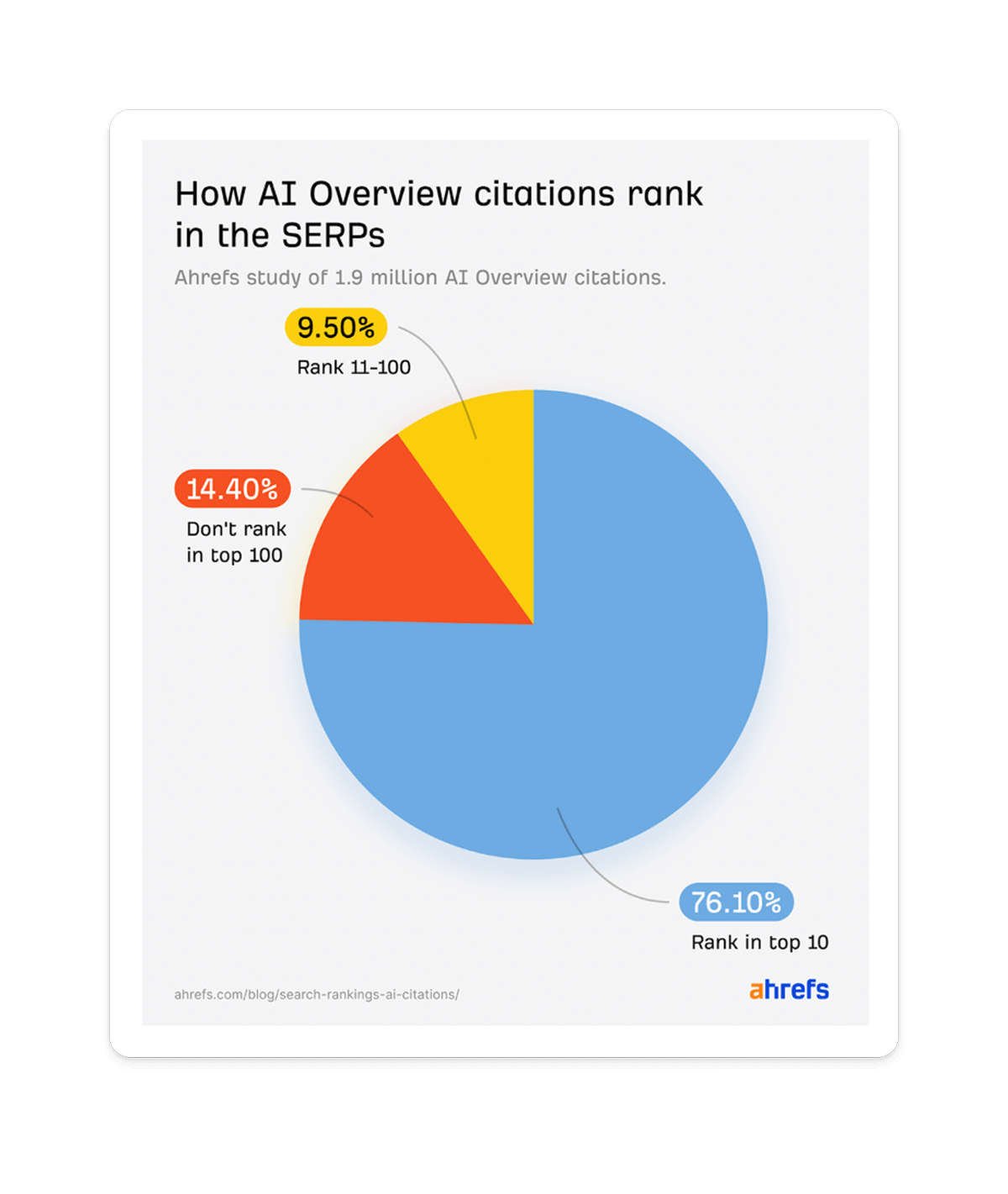
Image source: Ahrefs
There are plenty of other techniques you can work into your content strategy framework to increase your chances of being cited by LLMs.
This includes answering query questions directly and clearly, making content easy to understand for improved user experience (UX), and including original insights or data where possible.
By adding key details to signal credibility, like author attribution and bios, publication dates, and recent updates will help search engines and LLMs understand your content in more depth.
⚡ To learn more, check out Hive19’s guide to optimising SEO content for AI Overviews and LLMs.
Step 5: Use content scheduling tools
Consistency is essential when executing your content marketing strategy. Regular publishing helps establish credibility, signals that your business is active, and helps earn and build trust with your audience.
It’s also essential for SEO and AEO. Consistent, high-quality content sends all the right signals to search engines and LLMs, helping them better understand your brand, your expertise, and the value you provide. The more quality content you produce, the stronger your authority becomes.
How often you need to publish new content varies depending on your channel. If you have a blog, HubSpot recommends 2-4 posts a month is a standard benchmark, but it all comes down to quality.
At Hive19, we often work on one expert quality blog a month or a 10x refresh of older, lowering performing content. We’ve found this is more effective than writing shorter, less informative blogs and encourages a high volume of quality backlinks from sites with relevant authority to our industry.
For social media channels, it varies depending on your platform.
Hannah Macready from Hootsuite shares a rough guide to how often to post on each platform:
- TikTok: 3 – 5 times per week
- Instagram: 3 – 5 times per week
- Instagram Stories: 2 times per day
- X (Twitter): 2 – 3 times per day
- LinkedIn: 1 – 2 times per day
- Threads: 2 – 3 times a day
- Facebook: 1 – 2 times per day
- Pinterest: At least 1 time per week
- Google My Business: At least 1 time per week
Unless you have a massive marketing team, maintaining that schedule is going to be tricky (to say the least). That’s why we recommend using scheduling software. This allows you to plan out your content marketing ideas and upload posts to be published on specific dates, ensuring you’re always ahead of schedule.
For content production scheduling and management, check out:
| Feature | Best for |
|---|---|
Hootsuite |
Teams managing multiple social channels. |
Trello |
Smaller teams that prefer simple, Kanban method to organise tasks. |
Asana |
Content teams who need structured workflows, deadlines and wider team collaboration. |
Monday.com |
Visual planners who like flexible dashboards to manage content calendars and team capacity. |
Airtable |
More advanced content teams that need database-style organisation and customisable views. |
These tools help simplify the creation, publication, and tracking of your content strategy.
Step 6: Promote, distribute, and measure performance
Big news: you’ve reached the final step of your content strategy!
This is where the focus turns to promotion and performance, releasing your content for all the world to see.
Without wasting any time, let’s jump straight into content marketing best practices for promotion and distribution.
Channels for content distribution
Getting to grips with the different channels you can publish on gives you a solid foundation for your next steps.
We like to split distribution channels into 3 categories; owned, earned and paid:
- Owned: These are owned distribution channels that you can use to organically reach your audience, like your blog or an email list.
- Earned: You can boost your content’s visibility by earning backlinks, guest posts, and working with PR teams. Many of these are beneficial for increasing visibility of your owned channels, too, by boosting your SEO and AEO.
- Paid: Think social media ads, pay-per-click, and sponsorships. Essentially, this is the non-organic side of content marketing that can earn you a whole lot of visibility.
A considered strategy uses a blend of each method. For instance, if you’ve developed a B2C wellbeing app you might carry out a lot of your marketing on social media – direct to consumer and where your audience typically are active..
The content you publish directly to your social media profile ticks the box for ‘owned’ distribution, while organic mentions from other content creators are ‘earned’, and your sponsored posts and influencer marketing fall under ‘paid’.
Which type of content is the most effective on which platform?
There are a lot of distribution platforms to pick from.
Blogs, articles, and other forms of written content are great to share on your website, for instance. For videos and images, social media channels are a solid go-to.
The platforms you focus on will depend on your target audience.
Let’s say you’ve developed software for professionals and are looking to distribute it on social media. LinkedIn is the obvious choice. It’s specifically geared towards a professional market and has over 1 billion professionals already using the platform.
If you’re appealing to a Gen Z target audience, Instagram, YouTube, and TikTok are the most popular platforms.
You can also work out which platforms to use by checking out where your competitors are focusing their efforts. This will give you insights into how your target audience is being reached, where they spend the majority of their time, and which channels might be the most effective for your niche.
⚡ Expert tip: Avoid spreading yourself too thin across too many platforms. It’s better to dominate across one or two channels than attempt to do it all and fail to communicate your brand effectively.
Future-proofing your content for AI Search and LLMs
Our last piece of advice is to never expect the marketing and content landscape to stay still.
Just as we’ve seen in the past few years, the goal posts for effective, lead-generating content can change overnight. As AI search and LLM algorithms evolve, so too should your content strategies.
Brands everywhere are working hard to adapt their content marketing strategy to suit this new era of discovery search, and it’s important not to get left behind.
The great thing about change, though, is that it creates a more even playing field for new brands to rise to the top.
Are you ready to seize the opportunity?
If so, we can help. At Hive19, we use data-backed insights and target market research to develop digital marketing content strategies that stand out. Get in touch to find out more.
Content strategy for search and LLMs FAQs
The best content marketing strategy is one that’s based on clear, targeted research, including insights into your target market and relevant keywords. It should be goal-driven, too, ensuring you know what you want your content to achieve, and include a plan to track success over time.
We highly recommend considering Google’s E-E-A-T guidelines if you want to create an effective content marketing strategy. This ensures you’re focusing on content that aligns with search engines, LLMs, and your target audience for a balance between organic visibility and driving conversions.
Make sure your strategy is flexible, too. It’s crucial that you’re tracking the success of your campaign over time and using this to adjust your original methods, streamlining your marketing for the greatest ROI.
A business-to-business (B2B) content marketing strategy is designed to engage other businesses. It focuses on data-driven insights and real-world proof, so that your audience can see the value in your product.
For instance, you might be selling software to e-commerce brands to improve their customer management. Your marketing strategy would focus on how you can help these businesses overcome common challenges, build better relationships with their customers, and improve their ROI.
A business-to-customer (B2C) marketing strategy engages individual customers, with products or services designed for personal use. Strategies tend to focus more on storytelling and emotive marketing.
If you’re selling a budgeting app to individual customers, for instance, you might centre your strategy on being relatable and understanding your customers. This could include blogs on overcoming common money mishaps and short-form videos of how to hit financial goals.
Absolutely! A content strategy is based on research and data, ensuring you’re focusing on marketing techniques that align with your goals, including boosting organic visibility in traditional search, AI overviews, and LLMs like ChatGPT and Copilot.
While an increasing number of online users are using LLMs and AI overviews, SEO is still highly relevant. By incorporating SEO best practices into your digital marketing (like following Google’s E-E-A-T principles), you strengthen your chances of appearing organically in both SERPs and AI search.
Use a combination of evergreen and seasonal content, follow Helpful Content principles, and use KPIs to track, monitor, and improve your content strategy framework.