
If you’re a brand or agency looking to improve organic visibility and authority, understanding how to earn quality backlinks can be just as important as the links themselves.
Among the most popular strategies, often used interchangeably, are guest post services and blogger outreach services.
While both fall under the umbrella of content marketing and search engine optimisation (SEO), they serve very different purposes, require their own unique approach and come with varying levels of control, investment and return on investment (ROI).
Here we’ll be looking at:
- The key differences between guest posting and blogger outreach.
- A detailed step by step breakdown of both strategies.
- Where they deliver the most value for a brand.
- Best practices to use them as part of a holistic content marketing strategy.
So, whether you’re deciding between different outreach methods or looking to optimise your current link building strategy, this guide will help you gain a better understanding of the benefits and best practices for both guest posting and blogger outreach services.
What is guest posting?
Guest posting (commonly known as guest blogging) focuses on writing and publishing content on a website that you don’t own.
The content you publish on a third party website could be:
- Articles
- Guides
- Interviews
- Listicles
The common theme is that it will include a brand mention or a backlink to your website within the content.
One of the benefits of guest posting is that you maintain greater control over the content that’s written, including:
- The topic and how it’s covered.
- SEO optimisation.
- Anchor text and backlink placement.
All while providing third party publications or topically relevant sites with fresh and relevant content without requiring them to create it in-house.
Guest posting helps you earn quality backlinks from authoritative domains, while showcasing your brand’s expertise, experience, authority and trust EEAT through sharing experience, opinions and content assets with a new audience.
Ready to build authority and earn backlinks through guest posting?
Showcase your brand’s expertise with a powerful guest posting campaign. Get started with a quote
Guest post outreach workflow
Guest post outreach generally follows the process of:
1. Identify relevant websites that are complementary to your niche.
2. Validate suitable contacts on the website you’re targeting to make contact.
3. Outreach and pitch content ideas or a completed resource to the target website.
4. Create the content with your combined target audience in mind.
5. Include an SEO optimised backlink to your website naturally within the content. Avoid shoehorning or keyword stuffing as this can attract manual penalties from Google.
6. Publish! Your content is now live, you’ve earned a new referring domain to your website, wahoo!
7. Track your live publication for ranking keywords, organic traffic, referral traffic and social shares.

While the third party website will always have the final signoff on anything that’s published on their site, guest posting offers comparatively more freedom in terms of content creation and the final version of your guest post once it’s live.
In our experience, any website worth its link juice will have strict content requirements, guidelines and expectations for external contributors writing for their audience.
⚡ Expert tip: No guidelines? That’s a red flag in our books. If a website isn’t setting quality standards, chances are it’s not maintaining them. Always check the existing content on the website you’re targeting. If it’s thin, spammy or packed with keyword heavy links, it’s one to avoid.
Understanding a website’s audience, tone and style when speaking to their target audience will make all the difference between creating an exceptional guest post that editors will bite your hand off to publish and just another piece of generic content that provides no value to audiences online.
Take the time to understand their products or core offering and how you can weave these naturally within your content to make it hyper relevant for their audience.
Without this deeper understanding, your post might get published, but it’s unlikely to perform as well as a highly topical and relevant piece written with their audience in mind and is less likely to provide as much return for your SEO link building campaign.
What is blogger outreach?
Blogger outreach consists of reaching out to bloggers, influencers or online publishers to secure coverage or mentions of your brand within their content.
Blogger outreach generally involves the content being written and published by the blogger, making the collaboration feel more organic and authentic to their audience. This includes:
- Brand mentions in editorial content or niche articles.
- Product reviews.
- Expert commentary or quotes for roundup style posts.
- Inclusions in listicles such as “Best [industry tool] for startups”.
- Case studies or success stories featuring your product or service.
- Tutorials or how-to guides that recommend your brand as a resource.
The website owner or marketing team creates and publishes the content, not you. That is the key difference between guest posting and blogger outreach – you’re asking for placement in content they control or create themselves, rather than providing the content to the website.
Blogger outreach workflow
1. Identify bloggers, influencers or online publishers whose content and audience align with your niche or brand goals.
2. Research existing content opportunities (e.g. listicles, resource pages, review articles) that could naturally mention your product, brand or service.
3. Verify suitable contacts at the website you’re targeting. These will often be the owner, content manager or editor-in-chief.
4. Outreach and pitch explaining the mutual value of featuring your brand (whether through a quote, brand mention, product inclusion, or expert insight).
5. Negotiate terms of collaboration, which may involve compensation, a product sample or another form of exchange.
6. Provide the necessary information, assets or product details the publisher needs to create or update their content.
7. Review the final piece (if offered the chance) and confirm it includes your brand mention or backlink.
8. Track the performance of the placement (including referral traffic, engagement and SEO benefit).
It’s important to understand that blogger outreach is more likely to incur an element of “what’s in it for me” from your target websites.
For example, monetary compensation for the time it takes to edit existing content, a reciprocal backlink, or free products in exchange for mentioning your brand on their website.
A blogger or influencer’s endorsement can carry a lot of weight if your marketing key performance indicators (KPIs) focus on increasing brand awareness, brand exposure or social exposure.
The reference to your brand should be presented as a solution or trusted resource that provides an opportunity for their audience to expand their knowledge outside of what they are already covering within the body of the content.

Guest posting vs. blogger outreach: what’s the difference?
Both marketing tactics aim to earn relevant and quality backlinks to your website and increase visibility for your brand, product or service pages.
We’ve put together a comparison table to see the key differences between guest posting and blogger outreach.
This will help you decide which makes the most sense for your next campaign.
| Feature | Guest posting | Blogger outreach |
|---|---|---|
Content control |
You write and provide the content for them to publish. |
Blogger or publisher writes and publishes the content. |
SEO Targeting |
More control over keyword use, anchor text and link placement. |
Limited control – Link placement and anchor text are often down to them. You can request your preferred optimisation, but it’s not guaranteed. |
Tone of voice |
Brand-led – aligned with your brand tone and messaging. |
Influencer-led tone; often more personal or informal. |
Investment and resource |
Greater investment – you’re responsible for ideation, pitching, creating outlines, writing the content, editing and addressing feedback. |
Less investment but relies on stronger research, identification and effective outreach strategies. |
Trustworthiness |
It’s your content hosted on the third party’s website, so the trust depends on your brand recognition within your industry. |
It’s seen as an independent endorsement of your brand. You’re benefiting from their EEAT and relationship with their existing audience. |
Cost |
Lower costs are involved, especially when done at scale. |
Higher costs are involved – it depends heavily on influencer rates, free products or reciprocal arrangements. |
Audience targeting |
Niche targeting and topical relevance. |
Audience and community-driven. Opportunity selection is important for success and engaging their audience. |
Relationship building and networking |
More commonly, it will be a one-off or sporadic collaboration (e.g. 1 piece of content every 6-12 months, depending on the target website’s editorial schedule and your relationship). |
Greater potential for long term partnerships and influencer marketing collaborations. It often depends on the success of your first collaboration. |
Common use cases |
|
|
Guest posting and blogger outreach both have the potential to deliver long term SEO value for your business. However, your goals and marketing KPIs should guide which tactic you focus on, or how to combine them for maximum impact.
What are the benefits of guest posting?
Guest posts are a powerful way to earn relevant backlinks, but there are many other benefits for brands.
Guest post services, in particular, offer a unique set of advantages beyond simply earning coverage for your brand. Let’s take a look at a few of them in a bit more detail.
Greater control over brand messaging
Depending on the level of exposure, for example, is it advertorial in nature, or is it a ‘ghost post’, published under the website author’s name?
When you provide the content to the target website, you generally have more control over the messaging and subject matter.
In a ‘ghost post’, the ideal scenario is to fit seamlessly with the other articles already published on the website, so matching the third party’s tone and style is preferred. However, your link inclusion can be optimised for maximum SEO benefit.
In a more advertorial scenario, you have greater control over the entire content, as you’re paying for the feature. So, be sure to maximise the opportunity, style and tone for your brand and campaign goals.
SEO optimisation
It’s important to remember that the success of this activity will ultimately be dictated by the quality of the content.
Including a link or brand citation within the content is essential for the SEO benefit to your website – but that only has potential if the guest post itself showcases strong EEAT, provides unique insight or value to audiences.
You should only write a guest post for a website within your vertical or niche. This helps build topical authority for your business.
If your guest post is well optimised and provides helpful and accurate information, it’s more likely to rank higher in the search engine result pages (SERPs) for related keywords, providing maximum opportunity for organic traffic.
This not only increases the chances of referral traffic from the third party but is also a signal to Google that the content is high quality and the backlink is considered a more authoritative source. This is especially true in the era of zero click search and the future of large language models (LLMs).
Thought leadership
As mentioned, you should only really be writing guest posts for brands and businesses within your vertical or niche.
Providing your expertise to relevant figures within the industry helps grow your brand or that of your company and will demonstrate you as a thought leader.
E-E-A-T and people first content are both vital for organic search success. Being referenced by your peers and key players in your sector is one of the most effective methods for building an online reputation.
Professional growth
By partnering with other brands, leaders and publications within your niche, you not only gain greater brand awareness but also guest posting offers you an opportunity to contribute to a wider discussion online.
Use guest posting as a way to explore topics that you’ve always been interested in exploring in more depth.
Perhaps there is a common pain point felt among those also working in your industry, and you have a unique solution worth hearing about.
Guest posting on a valuable topic that can help people will position you at the forefront of your industry and as a credible source of information.
What are the benefits of blogger outreach?
Blogger outreach offers a unique way to build brand visibility and credibility quickly by tapping into and using the trust and influence bloggers and publishers have built with their audience niche.
Below are some of the key benefits you can expect from an effective blogger outreach campaign:
Wider reach, with comparatively less effort
Earn coverage and backlinks on pages that already rank well and receive regular monthly traffic, or by featuring in an upcoming post that is relevant to your brand.
Greater credibility
Blogger outreach can feel less promotional and advertorial when your brand is mentioned by a third party in their regular format, lending a different type of social signal and associated trust.
Authenticity
If the blogger you are approaching has a large audience and a consistent format for content, the exposure your brand can receive can carry a different type of trust.
This is perhaps more relevant at the influencer level of exposure, rather than the ‘mummy blogger’, but each has its own relative audience and merit of being included.
Audiences are accustomed to sponsorships with brands, though the authenticity is underpinned by the integrity, values and choices of the blogger aligning with those of its audience.
In most blogger outreach scenarios, an exchange is required. This can be either unique insights or knowledge that the blogger and their audience can benefit from.
In most cases, a commercial transaction, either a payment or a ‘freebie’ of a product, is provided.
Fruitful relationships
Establishing connections and building relationships with bloggers can lead to repeat collaborations, ongoing features and broader partnership opportunities, which, from an organic traffic perspective, can be a positive signal to search engines.
Smarter investment for product-led brands
Blogger outreach is often seen as a better investment for organic rankings, compared to sponsored content or paid advertisements.
Blogger outreach provides greater long term value for organic SEO growth, particularly when compared to other avenues of digital advertising.
According to a study by Picnic, a user-first media platform, and YouGov, consumers are showing an increasing distrust in traditional ads:

Quicker turnaround
Depending on the agreement with the blogger, this method does have the potential to be a quicker process than writing a guest blog.
If it’s inserting a link into an existing post in exchange for something of value to the blogger, it can be instantaneous.
However, in my experience, I would always lead with caution and question, ‘if it’s that easy, how valuable is it to my brand?’.
That’s not to say that there’s never value in quick transactions. Far from it. But, there are many websites set up precisely to charge for this activity, and search engines are well aware of this.
Backlinks should always be earned. They should not be achieved through a quick transaction, without any consideration of whether the backlink is actually helpful to readers or uplifts the content in some way.
Perfect for startups or unknown businesses
For startups or businesses that have only recently invested in online performance, time is of the essence and getting started is the key. Moving the needle a little quicker with some easy wins is a great way to get the ball rolling.
Always prioritise the relevance of each individual website or blogger to your brand over their availability, and check where else they
link to before jumping into the collaboration.
A website that links out to 1000s of domains, with little to no relevance amongst them, is likely to offer little value.
Instead, focus your efforts on being more selective when validating your prospects. Focusing on strong topical relevance within its referring and referred domains will be much more useful.
Guest posting vs. blogger outreach: why not both?
It doesn’t have to be about choosing one over the other. Often, the best marketing campaigns and strategies combine a mixture of tactics.
Both strategies bring their own strengths to the table:
- Guest posts offer control, precision, niche targeting and opportunities to showcase your EEAT. Sustainable growth, but it may take longer to see the results.
- Blogger outreach taps into trusted audiences and authentic engagement, focusing on a wider reach. Quicker impact, but it isn’t as sustainable in terms of consistent organic growth over time.
Focus your approach by aligning with your marketing priorities. Whatever route you take, be sure to plan, execute, tweak, test and review to achieve the best results from your outreach campaigns.
If you’re not outsourcing to a specialist marketing agency (like Hive19 😉), it’s worth considering the time, resources and skillsets you have in-house.
Are you set up to execute these types of outreach campaigns?
If not, our team of backlink specialists are always available to discuss your goals and campaign focus. Get in touch with Hive19
8 guest posting best practices
Whether you’re writing guest posts or pitching to established bloggers, a thoughtful and well-executed approach will make all the difference.
Below are some of our favourite, tried-and-tested strategies and tips to help maximise your chances of positive ROI for your outreach campaigns.
In this section, we’ll cover the following best practices:
1. Research and vet each opportunity thoroughly
2. Write your pitches with an editor’s mindset
3. Offer a unique angle or perspective
4. Position yourself as an expert
5. Optimise for SEO
6. Optimise your author bio
7. Offer a blog series
1. Research and vet each opportunity thoroughly
You want to ensure that the publication you’re targeting as part of your guest posting campaign aligns with the following checklist:
- Topically relevant to your product or service.
- Actively posting helpful and unique content that engages and provides value to their audience.
- Have they previously worked with brands similar to yours? This can indicate their openness to collaboration and the style of coverage you might expect.
- Has a strong domain authority and receives consistent levels of monthly traffic.
It’s worth using other key authority metrics during your vetting phase. This will help qualify your prospects and prioritise based on the potential impact of a collaboration with each publisher or blogger.
But, most importantly, does their audience overlap with your target market in terms of interests, needs, and behaviours?
If it does, it’s more than likely they’re a suitable prospect for your guest posting campaign.
⚡ Expert tip: Metrics are great, but they aren’t everything! Focus on whether it makes sense for my website to feature on this platform or website? Relevancy is everything when it comes to authority building within your niche.
2. Write your pitches with an editor’s mindset
Publishers receive hundreds of pitches every week, so focus your efforts on providing unique ideas for their consideration that have a real hook.
Be clear and transparent from your initial email about what value you can provide, what you expect in return and the process of creating content for their audience.
With every opportunity pitch, communicate and showcase your understanding of their specific target audience and the type of content they prefer to publish.
For instance, is it long form vs. short form, studies, interviews or industry insights? Then, use this analysis to tailor your pitch to the unique needs of each editor.
3. Offer a unique angle or perspective
We mentioned having a “hook”. This can be challenging, especially if your brand has been around for a while and you feel like you’ve tried every angle and completely far-fetched digital PR idea that you can think of.
But, unique content and a fresh hook are essential for a successful guest posting campaign. You’re trying to cut through the noise of a busy inbox and competing with 1,000s of other brands all fighting to work with that one powerhouse influencer, with over a million engaged followers.
Whether you’re drilling down to a subcategory of a particular topic and pain point or offering a completely new perspective on it, you need to be offering something to an audience that they can’t get elsewhere.
Starting to scrape the creativity barrel for your campaigns?
We love hearing about challenging niches or oversaturated industries and seeing where a potential gap could be. Book a 20 minute call with Maxine
4. Position yourself as an expert
As mentioned in the opening section, there are very few better ways to position yourself as an expert thought leader than by sharing your knowledge with brands and businesses in your industry.
However, to maximise your reach across the additional audiences provided by your target websites, you’ll need to offer a unique insight that is worthy of being cited in a piece of content.
Stats, opinions and images have long been the main source of citations (or links) within third party features, and the more authority or credible reputation you have to support your claims, the likelier it is to be included.
Artificial Intelligence (AI) has reduced the barrier to entry, meaning anyone can ask ChatGPT to create something that could be referenced. While that is great for the pitcher, it’s not so good for the publisher.
Instead, focus on what separates you from the crowd. Pitch only where you are an expert, or have something valuable to contribute to content that is already online.
E-E-A-T is cyclical, and the more you can provide, the more you will get back in return in the long run.
By showcasing your expertise, experience, authority and trustworthiness in your pitches and content, you’ll not only connect with editors and readers alike but also strengthen your brand’s reputation and ensure the long term value of each backlink and coverage you earn.
Rather than writing what’s easy and focusing on the quantity of links, draw on the things that make you an expert, and focus on pitching content that only you could produce.
5. Optimise for SEO
Prioritise SEO in your guest posting campaigns by incorporating relevant keywords and long tail variations that align with both the publication’s audience and your SEO goals.
Avoid over optimising your content or stuffing keywords in, it should always make sense and feel natural to audiences consuming your content.
Where possible, suggest meta elements like a page title, meta description, and even structured headings (H1s, H2s and H3s) to help the publisher and maximise their on page SEO value.
Spend time suggesting internal links to important key landing pages, existing resource hubs or cornerstone content already on their website that aligns contextually with your guest post.
This helps traffic flow throughout their website and is a strong signal that you’ve considered the publisher’s marketing and SEO strategy by saving them time. If you can make the collaboration less taxing for them, these are all areas that go in your favour for potential partnership work in the future.
Ultimately you want to create your content with a people-first, search-second mindset.
6. Optimise your author bio
Communicating E-E-A-T in your author bio will provide valuable insights about your expertise, achievements, and the value your opinions and insights can bring.
How you frame your author bio can make a significant difference in how both readers and search engines perceive your authority on a subject.
Google’s algorithms use author information to gauge content credibility, so make sure your bio is concise but aligns with the level of expertise you’ve displayed in the guest post.
Communicating your E-E-A-T in your author bio will provide valuable insights about your expertise, achievements, and the value your opinions and insights can bring.
One great example is Louise Linehan from Ahrefs:

Louise Linehan's Ahrefs author bio example.
Using Louise’s example, you can adopt the same structure and components to create your EEAT-focused author bio:
[Your full name]
[Job title] at [Company]
[Your name] is a [Job title] at [Company]. Over the past [number] years, [he/she/they] has [summary of relevant career experience, e.g. worked with X types of companies, held senior positions at Y companies]. During this time, [he/she/they] has [notable achievements, e.g. published X blog posts, led research, spoken at X industry events].
[Your name] first [notable starting point or breakthrough moment, e.g. learned the ropes of SEO, gained recognition, etc.]. [Brief story or specific success, including any recognisable brands, industry experts or companies involved].
Since then, [he/she/they] has written about [key topics or areas of expertise]. In [his/her/their] spare time, [personal development or side projects that reinforce expertise and experience].
You can find [first name]’s work in [notable publications, websites, or media appearances].
[Naked URL to personal website or company homepage]
Include a compelling call-to-action and links to your homepage, enticing readers to learn more about your brand.
One common mistake many leaders in the industry make is using the same author bio for every guest post.
⚡ Expert tip: While it may be easier to repurpose the same text for every guest post, we’d recommend tailoring your bio to each website and audience depending on the subject matter being covered.
When you personalise your bio, align it with the content of the post and the interests of the website’s readership, you not only make it more relevant but also more engaging for them specifically.
7. Offer a blog series
Propose the idea of a multi-post series to the third party’s blog. This approach involves contributing a series of interconnected guest posts, creating a narrative that spans multiple articles.
See Hive19’s example of our link building series over on our blog.
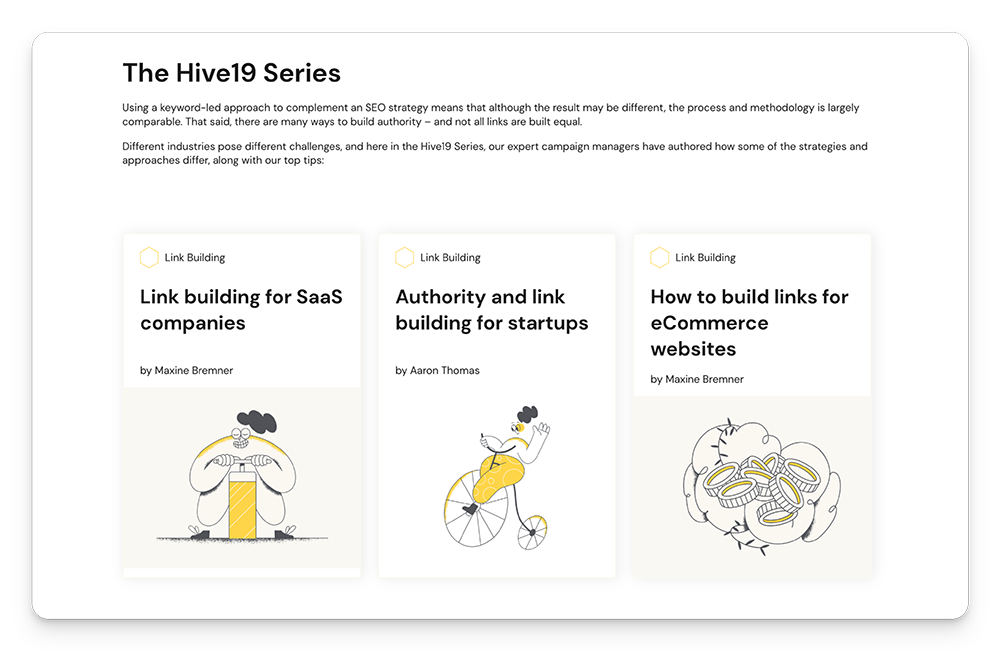
This can deepen reader engagement and encourage visits to specific pages for a comprehensive understanding.
If you’re a SaaS company specialising in project management tools, an example that you could pitch might be a 3 part guest post series around “Mastering remote team collaboration.”
- Part 1: Choosing the right tech stack for remote teams.
- Part 2: Best practices for managing deadlines and deliverables.
- Part 3: How to build a strong remote company culture.
Each article would link naturally to the next, while also linking back to your own relevant resources.
From an audience perspective, a blog series is effective in addressing a range of pain points for your target market in smaller, bite-sized articles.
This year, we’re seeing a shift in publishers’ wanting 700 word maximum articles. Indicating audiences’ needs and mindset are shifting away from 1,500 (sometimes even 3,000) word articles that cover every question within a subject matter.
A blog series allows you to break down complex topics into digestible, actionable pieces, which is particularly valuable for audiences looking for in-depth insights but don’t necessarily want to read a long form (3000+ words) resource.
Each article in the series builds on the last, providing a sense of continuity and offering more value than a single post ever could.
This deep dive into a specific subject keeps readers engaged over time, increasing their trust in your expertise. It also creates anticipation for your next article drop, and audiences may be encouraged to follow you on social media, waiting for you to share the follow up blog post.
From a search engine perspective, when audiences return to read the next part of the series, they spend more time on your website, a signal to search engines that the content produced and authored by you is relevant and valuable when addressing their needs.
Over time, a blog series helps build topical authority. Search engines recognise that you’re a comprehensive source for the subject matter, which can lead to higher rankings for related searches in independent organic searches.
4 blogger outreach best practices
Building meaningful relationships and securing valuable coverage and quality backlinks takes more than just identifying a few influential people within your niche and firing off cold emails willy-nilly.
Successful blogger outreach comes from thoughtful strategy, genuine relationship building that benefits both sides of the partnership.
Here we share our best practices to help you stand out in noisy inboxes, build meaningful partnerships and land powerful backlinks that drastically improve your brand’s positioning online.
1. Understand and segment your target bloggers
2. Personalise every outreach email
3. Treat it like networking (not cold calling!)
4. Test and refine your outreach approach
1. Understand and segment your target bloggers
Blogger outreach is more than just casting a wide net of prospects and hoping for the best.
To be successful in blogger outreach, it’s all about effective targeting, at the right time, with a message that genuinely resonates with them.
You’ll need to move beyond sending a mass bulk pitch to a list of 1,000 potential bloggers.
Instead, create a tailored outreach strategy that speaks directly to the needs of both the blogger and their target audience. Do this by segmenting them by:
- Topic
- Niche
- Authority
- Engagement levels
While domain authority (DA) and estimated traffic are important for evaluating a blog’s potential SEO value, engagement metrics should be considered when assessing potential prospects for blogger outreach.
⚡Expert tip: At Hive19, we look at wider metrics including social shares, comment activity, and how often other websites reference their content. These signals show that the blog has an active, invested audience, which can help your content gain traction more quickly. You can discover these insights and more by using industry tools such as Ahrefs, Buzzsumo and Semrush.
2. Personalise every outreach email
Even if you are already working at scale, avoid sending generic outreach emails that only personalise the first name of the contact you’re emailing and the target website name.
Now, you may not have the bandwidth to fully personalise every single email manually. At the very least, your pitch emails should demonstrate that you know key details about the blogger you’re reaching out to.
Basic personalisation for blogger outreach
At a bare minimum, these are the areas you need to be personalising in your emails:
- Address your email specifically by name.
- Show an understanding of their background and professional accolades.
- Include a detailed, honest explanation of why you want to work with them and how your product or service could help their audience.
Advanced personalisation for blogger outreach
If you’re looking to level up with more creative, advanced outreach practices that go beyond the basics, try:
- Show that you’ve done your homework and understand both their platform and values. Communicate this in your initial blogger outreach email.
- Offer a collaborative piece. Co-create a content asset with the blogger to showcase both of your expertise. This not only provides fresh content but also promotes cross-promotion to both audiences.
- Rather than talking about your product, position it as a solution or resource that aligns with the blogger’s audience’s needs, showing that you’ve put thought into how your brand aligns with their community.
- Warm up your targets by sharing or engaging with their content, link to their work in your blog or newsletter before pitching. This is a subtle way for your outreach.
- Use social proof with FOMO by mentioning recent successful collaborations or media coverage to signal credibility. For example: “We’ve worked with [big name] and would love to include you as well.”
- Tailor the pitch to their goals. Whether they’re monetising through affiliate links or growing their audience, show how your pitch benefits their goals (e.g., “We can offer affiliate tracking” or “We’ll help promote your highest converting post for additional exposure”).
- Leverage exclusivity and scarcity by creating a sense of urgency and exclusivity: “This opportunity is only being shared with a select few” or “We’re closing placements by [date], would love for you to be featured.”
- When contacting influential brands or bloggers, avoid mentioning a recent blog they published – editors typically will roll their eyes at this approach.
For example, you’ve probably come across this style of outreach:
Subject Line: Loved your recent post on [Blog title] – quick idea for you
Hi [Name],
I recently came across your post, [Blog title], and really enjoyed your take on [mention a specific point]. You have a great understanding of [Topic].
I represent [Brand name], and we have an in-depth resource that would add value to your audience: [Resource URL]
If you’re open to referencing it in your existing blog, please let me know.
Looking forward to hearing from you.
Many thanks,
[Your name]
It’s been done a million times over and has lost its impact. Instead, deeply understand your target’s pain points, content gaps that could potentially be filled by your content and craft your pitch accordingly.
Here’s a template that has worked well for us at Hive19:
Subject Line: Original resource to support your latest post on [topic]
Hi [Name],
I’ve been looking at your content on [Blog title], particularly your resources around [specific theme, category, or topic].
One thing I noticed is that while you’ve covered [mention related topics they have], there seems to be room to explore [identified content gap or audience interest].
This is something I can help with and have direct experience in. At [Brand name], we recently [conducted a study, worked with X clients, built a resource] that uncovered [specific, valuable insight].
This could offer real, actionable value for your readers who are interested in learning more about [subtopic/solution].
If this sounds relevant, I’d love to share more details or brainstorm how we could work together to genuinely support your audience.
No pressure at all, just thought I’d share in case you’re planning any updates or expansions to the piece.
Kind regards,
[Your name]
Want to learn more about Hive19’s Brand Outreach retainer model?
We maximise the reach, partnership potential and quality of links with a brand-domain email address. Book a call with Aaron to discuss
3. Treat it like networking (not cold calling!)
Unlike sales, blogger outreach isn’t all a numbers game.
With each new pitch you line up, be sure you have a strong, unique selling proposition (USP) that communicates the value writing about your product or service will bring to them and their audience.
Your aim shouldn’t be about getting a quick win, but to create a long term, mutually beneficial partnership.
Before you pitch, shift your mindset and define your hook from “What can I get?” to “What do I have to offer?”.
For example, can you help them:
- Create content that covers a trending topic relevant to their niche?
- Offer exclusive access to a product or event?
- Provide a quality evergreen resource they can’t create themselves?
- Solve a real problem for their audience?
Make sure you’re offering something that’s relevant and valuable to your prospects. Anything that addresses a key pain point for their audience that they can’t solve or provide a solution for themselves without you.
4. Test and refine your outreach approach
Influential bloggers receive a flood of outreach emails every day. The majority don’t even get opened and are moved straight to their bin – or worse, marked as spam.
For your brand to make it to the top of the pile and actually get a reply, you need to have a quantifiable way of knowing what works and what doesn’t.
Every successful blogger outreach strategy should be agile by nature. Informed by rigorously testing the types of publications you target, the content of your outreach emails and the end results from the content that’s published.
A few ways to test and experiment with a blogger outreach strategy are:
A/B test your email subject lines
Try different variations to see which generates higher open and engagement rates.
For example, create one campaign with a more personalised subject line vs. a more direct or value-driven one.
Run both for a month and then review open rates, reply rates and success rates.
⚡ Expert tip: At Hive19, we only review success metrics after sending at least 100 emails from each campaign. We analyse the results, tweak by reviewing responses and areas where our templates can be improved, and then relaunch a clone campaign and compare the difference.
Tweak your email copy
Try variations in tone (formal vs. casual) or structure (short, to the point vs. more detailed and persuasive).
Refine your approach based on responses
Never ignore feedback, even if it’s negative. It’s often a goldmine of ways to improve your outreach strategy going forward.
If a contact gives reasons as to why they aren’t interested in your pitch (e.g., it doesn’t align with their audience, or they’ve already covered similar topics in the past), use this insight to further refine any future opportunities going through the same campaign or pipeline.
Optimise based on real results
Don’t get too caught up in the open and reply rates.
The real measures should be which placements have helped create awareness for your brand, generated clicks, or earned a quality backlink from a relevant website or publication.
How to outsource your link building
If you don’t have a dedicated in-house team, blogger outreach and guest posting can be extremely time consuming and resource heavy.
If you’re short on capacity or simply want to scale your efforts, outsourcing your guest post or blogger outreach strategies to a trusted content marketing agency like Hive19 cuts out a lot of manual work, minimises the operational burden and can result in better ROI by leaning on proven methodologies around link building and content marketing.
If you’re an agency looking for support with your link building services, this is where white label link building services come in.
Partnering with a niche agency like Hive19 gives you access to expertly managed guest posting and blogger outreach campaigns, with a proven track record for securing highly relevant, authoritative backlinks across a variety of industries.
We understand audience behaviour, search intent, and the publishers that hold real influence, helping our clients earn authoritative links and appear where their customers are actively searching online.
Missing out on link building in your agency pitches?
Outsource to a reliable agency partner that can seamlessly integrate into your existing offering and avoid the hassle of hiring in-house. White label your SEO links
It takes time to build meaningful relationships, so be wary of agencies that overpromise on volume or turnaround speed.
Quality outreach and securing trusted links can’t be delivered within a 24 hour timeframe. If this is the case, they are most likely using (or are part of) a private blog network (PBN), which can harm your domain in the long run.
Another consideration is how they create the content that’s going to feature your brand name or backlink.

Download Hive19's most popular eBook: "Questions to ask your link builder"
DownloadWe’ve put together an extensive eBook that covers ‘Key questions to ask a link building agency’, but to share a few relevant questions when considering outsourcing your guest blogging or blogger outreach, take a look:
- Who writes the content? What are their credentials that make them an expert to cover the topic?
- What quality measures are in place when validating a suitable placement or publisher?
- What is the content creation process? How much control do I have over the final copy?
- How do they price earned coverage or link placements? Is it charged per placement, or do they offer a retainer model?
- What is the expected timeline for seeing live links and results? This will help set expectations for both parties.
These questions can help you assess whether a link building agency is suited to you and your campaign goals, especially if you’re offering link building as a service to clients under your own brand.
We love doing all the heavy lifting and leg work, you get all the credit and provide additional service that better serves your clients. Plus, it means you can determine your own profit margin on top of our link building services.
Part of a wider marketing strategy
This comprehensive guide has explained the difference between guest blogging and blogger outreach and how both can be used to achieve better organic rankings in search and build brand awareness for your business.
Guest blogging and blogger outreach should always be used as part of a wider marketing strategy.
If you’re looking to achieve greater authority for your domain and introduce your products and services to niche audiences but don’t have the resources in-house to run a consistently effective campaign, get in touch with our team of specialist content marketers and link builders.
Below, we’ve answered some of the most common questions associated with the differences between guest blogging and blogger outreach.
Guest post and blogger outreach FAQs
Both have their strengths and weaknesses. Blogger outreach is easier and less time consuming, guest posting offers more control over the final product, but requires more resources for the content creation.
At Hive19, we offer guest post services for clients looking for highly targeted SEO benefits and our blogger outreach services are perfect for brands looking to achieve broader brand visibility within the market.
Start with leading industry publications and websites that are popular among your customer base. Target these first and then work backwards.
Use industry tools such as Google, Ahrefs and BuzzSumo to streamline your research. You can look at competitors’ backlink profiles with a free website authority check to identify the top 20 backlink opportunities for your brand.
Typically it takes 3-6 months to see initial SEO improvements from link building, though particularly respected or authoritative domains may see results quicker due to how often Google crawls these domains and passes the ‘link juice’ back to your website through backlinks.
The timeline depends on link quality, keyword competition and other SEO factors. Link building works gradually, building domain authority over time.